AI estimate as of October 7, 2025 · verify with a professional before acting
AI-Generated · Verify before acting
Everything on this page is generated by AI for informational purposes only. AI can make mistakes — the AI may misidentify items or misattribute them (artist, maker, brand, designer, origin, era). This is not an official valuation and should not be used for insurance, sale, tax, estate, legal, or lending purposes — or any decision requiring a certified appraisal. It is not an authoritative claim about any person, brand, or rights holder — do not share or rely on it as a factual statement about a third party. Always consult qualified professionals before making financial decisions.
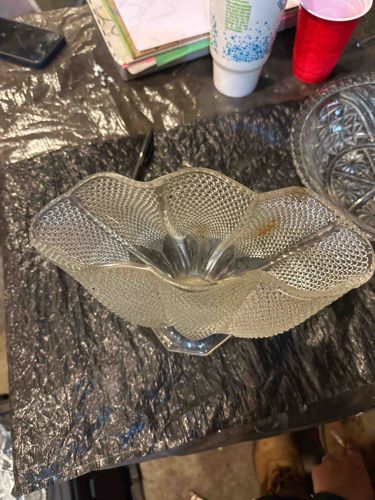
This item is a clear pressed glass bowl, characterized by its distinctive ruffled or scalloped edge and a textured honeycomb or waffle-like pattern covering its exterior sides. The bowl has an undulating, flower-like perimeter when viewed from above, with several pronounced peaks and valleys. The interior base of the bowl appears to have a starburst or radial fluted design, transitioning into the textured pattern on the sides. The base of the bowl is octagonal, providing stability and a visible support structure, suggesting it is an integral part of the molded design rather than an added pedestal. The material is clear, colorless glass, likely a soda-lime glass, commonly used in pressed glass manufacturing. Visible condition issues include what appears to be some brown discoloration or residue within the textured pattern on one of the ruffled sections, possibly indicative of dirt, rust, or food remnants that have settled into the crevices of the pattern over time. There are no obvious chips, cracks, or significant repair marks visible from the provided image, but a thorough inspection would be required to confirm this. The craftsmanship suggests a mass-produced item, typical of pressed glass, which became popular from the late 19th through the mid-20th century. The intricate pattern and form indicate a decorative as well as functional piece, likely used for serving sweets, fruits, or as a centerpiece. Without specific maker's marks, which are often absent or very subtle on pressed glass, an exact manufacturing detail is hard to ascertain, but the style is consistent with American or European pressed glass from the 1930s-1970s. The quality is typical for pressed glass of the era, offering decorative appeal with good durability.
AI Appraisal Report
Upon visual examination of this pressed glass bowl, I note it is a mass-produced, decorative piece, likely American, dating from the mid-20th century (c. 1930s-1970s). The design features a prominent honeycomb or waffle pattern with a ruffled edge and a starburst base, which are characteristic of this era. The condition appears to be fair to good; while no major chips or cracks are visible from the image, there is noticeable brown residue accumulated in the crevices of the textured pattern, which detracts slightly from its aesthetic appeal and value. This discoloration would need to be cleaned to properly assess for any underlying damage. The market for common, unmarked pressed glass of this type is quite saturated. While decorative, these pieces are not rare. Comparable honeycomb-patterned bowls from manufacturers like Anchor Hocking or Indiana Glass frequently sell in this price range in online marketplaces and antique malls. The primary factor limiting the value is its status as a common, mass-produced item without a discernible maker's mark or notable provenance. Demand is modest, driven by decorators and casual collectors rather than serious glassware connoisseurs. A higher value would be contingent on identifying it as part of a more desirable or rare pattern. A complete authentication is limited by the image-based assessment. For full verification, an in-person examination would be necessary to check for subtle maker's marks, examine for any hidden damage or repairs under magnification, and assess the glass for telltale signs of specific manufacturing techniques or age.