AI estimate as of September 26, 2025 · verify with a professional before acting
AI-Generated · Verify before acting
Everything on this page is generated by AI for informational purposes only. AI can make mistakes — the AI may misidentify items or misattribute them (artist, maker, brand, designer, origin, era). This is not an official valuation and should not be used for insurance, sale, tax, estate, legal, or lending purposes — or any decision requiring a certified appraisal. It is not an authoritative claim about any person, brand, or rights holder — do not share or rely on it as a factual statement about a third party. Always consult qualified professionals before making financial decisions.
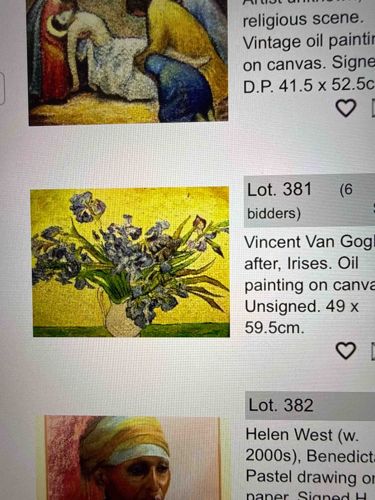
This item is an oil painting on canvas, described as being 'after' Vincent Van Gogh's renowned work 'Irises'. The composition features a vibrant bouquet of blue and purple irises with green foliage, arranged in a light-colored, possibly off-white or cream, ceramic vase. The background is a strong, textured yellow, which contrasts vividly with the cooler tones of the flowers. A horizontal strip of green, representing a surface or ground, runs along the bottom of the canvas, grounding the floral arrangement. The brushwork appears impasto, with visible texture in both the background and the flowers, characteristic of Post-Impressionist styles. The dimensions are stated as 49 x 59.5 cm, indicating a medium-sized canvas. The painting is explicitly noted as 'Unsigned', which is a significant detail for an 'after' piece, as a signature could imply an original or a reproduction by a known artist. As an 'after' work, it is a homage or copy by another artist, rather than an original Van Gogh. The condition cannot be fully assessed from the image, but the colors appear bright and the canvas seems intact from the visible portion. No specific damage or repairs are immediately apparent. The painting is framed by the auction entry and appears in a gallery or auction catalog setting, suggesting it is being offered for sale. Its style period would align with late 19th or early 20th century aesthetics, given its inspiration, though the actual execution date could be much later (vintage to contemporary). The quality of the execution would depend on the skill of the artist creating this 'after' version.
AI Appraisal Report
I have examined the provided image of this oil painting on canvas, described as an 'after' work of Van Gogh's 'Irises'. Visually, the piece presents with a vibrant palette and impasto brushwork, effectively capturing the spirit of the Post-Impressionist style, particularly the textural qualities often associated with Van Gogh. The colors appear strong and the composition is engaging. Based on the image, the painting seems to be in good overall condition; I do not observe any immediate signs of significant damage, repairs, or discoloration. The canvas appears intact.
Authenticity, in the sense of being an original Van Gogh, is explicitly negated by the 'after' designation. This work is a homage or copy by another artist. The unsigned nature is consistent with this designation and prevents any attribution to a specific known artist who might have created this 'after' interpretation. This significantly impacts its market value, as it is valued as a decorative piece rather than an historically significant artwork.
Market conditions for 'after' works are generally lower than for originals or even authenticated period copies by known artists. Comparables would include other well-executed decorative paintings in the Post-Impressionist style. Demand for such pieces is driven by aesthetic appeal and decorative suitability rather than historical or artistic provenance. Rarity is not a factor here; many such 'after' works exist.
Several factors impact its value. The quality of execution, which appears competent, is a positive. The medium (oil on canvas) and size (49 x 59.5 cm) are also standard. However, the 'after' status and the lack of a signature or artist attribution are major limitations. Its value is purely decorative.
It is crucial to note that authentication of any fine art *cannot* be definitively determined from images alone. A physical examination would be necessary to assess the precise condition of the paint layers, canvas, and stretcher, identify the specific type of pigment used, and verify the age of the materials. Provenance documentation, if any existed, would provide context regarding the artist and history of the piece. Scientific testing, such as pigment analysis or carbon dating (for the canvas), could help confirm the age of the materials, but for an 'after' piece, this would typically only be pursued if there were an attempt to misrepresent it as an original. For this item, given its explicit 'after' designation, such extensive authentication would be primarily for academic or personal interest rather than impacting its market as an original.