These notes were written by the person who submitted this item. Appraiser.AI has not verified them, and the AI's identification and estimate may rely on them.
AI Estimated Value
Not an official valuation
$25-50
AI estimate as of October 2, 2025 · verify with a professional before acting
AI-Generated · Verify before acting
Everything on this page is generated by AI for informational purposes only. AI can make mistakes — the AI may misidentify items or misattribute them (artist, maker, brand, designer, origin, era). This is not an official valuation and should not be used for insurance, sale, tax, estate, legal, or lending purposes — or any decision requiring a certified appraisal. It is not an authoritative claim about any person, brand, or rights holder — do not share or rely on it as a factual statement about a third party. Always consult qualified professionals before making financial decisions.
This analysis also relies on unverified notes provided by the user, which may be incomplete or inaccurate and could affect the result.
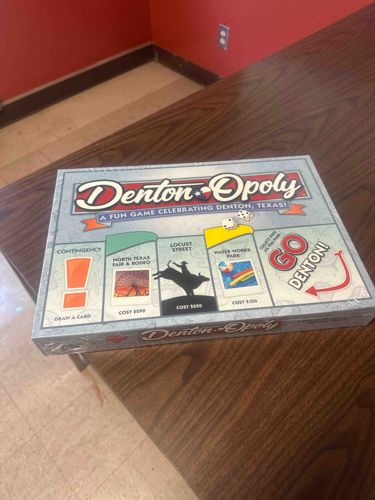
This item is a factory-sealed board game titled "Denton-Opoly." The game is presented in a rectangular cardboard box, typical for board games, and appears to be wrapped in its original clear plastic shrink wrap, indicating it is new or in pristine, unopened condition. The top of the box features the game's title prominently in a stylized font, "Denton-Opoly," with a subtitle that reads, "A FUN GAME CELEBRATING DENTON, TEXAS!" The color scheme for the title uses red, blue, and white with a starry motif. The box art depicts various squares reminiscent of a classic real-estate trading game, customized with Denton-specific landmarks or themes. Observable squares include "CONTINGENCY" (with an orange exclamation mark and 'DRAW A CARD' instruction), "NORTH TEXAS FAIR & RODEO" (cost $250, with an image of a Ferris wheel), "LOCUST STREET" (cost $150, with a silhouette of a bull rider), "WATER WORKS PARK" (cost $150, with an image of a colorful water slide), and a 'GO DENTON!' square with an arrow, similar to the 'GO' square in Monopoly. Two white dice with black pips are also visible in the artwork. The overall aesthetic suggests a locally themed version of the popular Monopoly game. The box edges appear crisp and the colors vibrant, showing no visible signs of wear, dents, tears, or discoloration due to being sealed. The craftsmanship appears to be standard for mass-produced board games, with good quality printing and sturdy packaging. The estimated age would be contemporary, likely produced in the late 20th or 21st century given its theme and appearance, perhaps as a novelty or souvenir item for the city of Denton, Texas.
AI Appraisal Report
I've examined the provided image of the 'Denton-Opoly' board game. The item appears to be factory-sealed in its original shrink wrap, indicating it is in new, untouched condition. The box art is vibrant, and the edges are crisp, with no visible signs of wear, damage, or discoloration. This pristine condition significantly contributes to its appeal, especially for collectors.
This game is a localized version of the popular 'Monopoly' format, customized for Denton, Texas. These 'ville-opoly' games are mass-produced as novelty or souvenir items, typically sold in local gift shops or through regional retailers. Authenticity, based on visual assessment, appears to be genuine for a commercially produced product of this type. There are no indications of it being a counterfeit; however, without handling the physical item, I cannot conclusively verify the quality of the shrink wrap seal or the printing process beyond what is visible.
Market conditions for such localized board games are generally niche. Demand is primarily from residents, former residents, or enthusiasts of Denton, Texas, looking for a unique memento. These items are not typically rare; they are produced in sufficient quantities to meet local demand. Consequently, they do not usually command high prices on the secondary market unless they are from an exceptionally limited print run or have significant historical relevance, which is not indicated here.
Comparable items, such as other 'city-opoly' or 'college-opoly' games, usually retail new for $20-$40, and their secondary market value typically stays within or slightly above that range if unopened. The primary factors impacting its value are its sealed, never-used condition and its appeal to a specific local demographic.
To fully authenticate, a physical inspection would verify the integrity of the shrink wrap, the physical quality of the components, and could potentially reveal any manufacturer's marks or print details not visible in the image. Provenance documentation would be useful to confirm its origin and purchase date, though for a contemporary, mass-produced item like this, it's less critical unless a specific limited edition is claimed.