AI estimate as of July 24, 2025 · verify with a professional before acting
AI-Generated · Verify before acting
Everything on this page is generated by AI for informational purposes only. AI can make mistakes — the AI may misidentify items or misattribute them (artist, maker, brand, designer, origin, era). This is not an official valuation and should not be used for insurance, sale, tax, estate, legal, or lending purposes — or any decision requiring a certified appraisal. It is not an authoritative claim about any person, brand, or rights holder — do not share or rely on it as a factual statement about a third party. Always consult qualified professionals before making financial decisions.
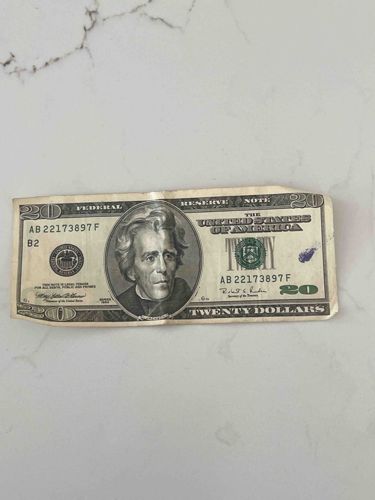
The item is a United States twenty-dollar bill, featuring a portrait of President Andrew Jackson on the obverse. The bill is predominantly green and white, printed on a linen-cotton blend paper specific to U.S. currency. It displays the serial number AB22173897F twice on the obverse: once on the upper left and once on the lower right, below the signature of the Treasurer of the United States. The series indicator below the left serial number is 'B2'. The text 'FEDERAL RESERVE NOTE' is printed at the top center. To the right of Jackson's portrait, the text 'THE UNITED STATES OF AMERICA' is visible above the prominent 'TWENTY' denomination. Two seals are present: the Federal Reserve Seal on the left, an inkwell-shaped design, and the Treasury Seal on the right, which is green. A notable distinguishing element is the presence of a purple ink or dye stain on the right side of the bill, near the top right corner and partially obscuring the value '20'. The bill shows visible signs of wear consistent with circulation, including creases, folds, and a general softened appearance of the paper, indicating it is not in pristine condition. There are no obvious tears or significant damage beyond the aforementioned stain and general wear. The craftsmanship is consistent with standard U.S. currency production, including intricate microprinting and security features typical of its era, though these are not fully discernible from the image alone. Based on the design, particularly the portrait and lack of larger numerals found on some later series, it likely belongs to a series from the late 20th or early 21st century.
AI Appraisal Report
I have examined the provided image of this United States Twenty-Dollar Bill. Based on the visual evidence, the bill appears to be an authentic U.S. currency note. The presence of President Andrew Jackson's portrait, the specific placement of serial numbers (AB22173897F, series B2), 'FEDERAL RESERVE NOTE' text, and the Federal Reserve and Treasury seals are consistent with genuine U.S. currency production of the late 20th to early 21st century. The craftsmanship, including the intricate details common to U.S. currency, further supports its authenticity.
From a condition standpoint, the bill exhibits clear signs of circulation, including multiple creases, folds, and a softened paper appearance, indicating typical wear and tear. A significant detractor is the purple ink or dye stain on the right side, partially obscuring the '20' denomination. This stain, along with the general wear, places the bill firmly in the 'Good' to 'Very Good' circulated condition range, rather than higher uncirculated or nearly uncirculated grades. There are no apparent tears or major structural damage beyond the aforementioned stain and general wear.
In terms of market conditions, demand for common circulated U.S. currency like a twenty-dollar bill typically aligns with its face value, unless it possesses rare characteristics such as a star note designation, a very low serial number, or significant errors. This particular bill does not exhibit any such rarity factors. Its serial number is not unique, and it is a standard issue. Therefore, it does not hold collector value above its monetary worth. The purple stain further diminishes any potential minor premium it might otherwise accrue if it were in a higher circulated grade.
Comparables would include any standard circulating twenty-dollar bill. Unless there's a specific, verifiable error or unique feature, such bills trade at face value in the general market. This bill's condition, especially the noticeable stain, prevents it from being desirable to collectors seeking higher grades or error notes.
Factors significantly impacting value are the general wear and, most notably, the prominent ink stain. These factors reduce its appeal to collectors to effectively nil, confining its value to its face amount. This bill possesses no inherent numismatic rarity or collectible features that would drive its value above $20.00.
Limitations of authenticity verification from images alone: While the visual elements strongly suggest authenticity, a full authentication would require in-person examination. This would involve tactile inspection of the paper's texture, thickness, and embedded security threads, examination under UV light for security features like watermarks and color-shifting ink, and microscopic analysis of microprinting and printing techniques to rule out high-quality counterfeits. Provenance documentation is not applicable here as it is a common circulating note. Scientific testing, such as ink analysis, would be necessary only in cases of suspected counterfeiting or alteration, which is not indicated by the image but cannot be definitively ruled out without physical inspection.