AI estimate as of November 21, 2025 · verify with a professional before acting
AI-Generated · Verify before acting
Everything on this page is generated by AI for informational purposes only. AI can make mistakes — the AI may misidentify items or misattribute them (artist, maker, brand, designer, origin, era). This is not an official valuation and should not be used for insurance, sale, tax, estate, legal, or lending purposes — or any decision requiring a certified appraisal. It is not an authoritative claim about any person, brand, or rights holder — do not share or rely on it as a factual statement about a third party. Always consult qualified professionals before making financial decisions.
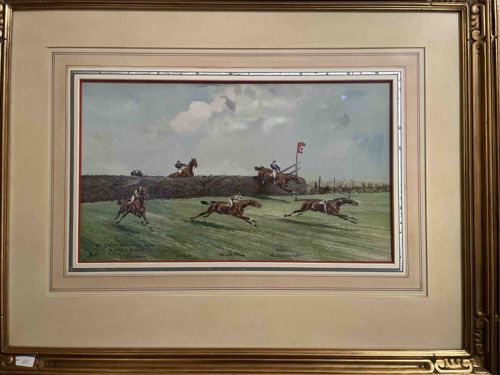
This item is a framed print depicting a dramatic steeplechase horse race. The print itself showcases several horses and jockeys in various stages of a race, with some actively jumping over a hedge obstacle while others gallop across a green field. The color palette is dominated by greens, browns, and blues, indicative of a natural outdoor setting under a partly cloudy sky. One jockey is seen clearing the hedge, denoted by a small red flag, while another horse and rider are just reaching the top of the fence. Two horses are in full stride in the foreground, with one prominently featured in a dark brown coat with white markings, and another slightly lighter in color. The overall composition suggests movement and competition. Text visible at the bottom left reads “PUBLISHED BY LAURIER & Co. 29. CHARING CROSS ROAD. LONDON W.C.” and at the bottom center "REYNOLDS & CO. NEW YORK." The print is housed within a multi-layered matting system, featuring an inner thin silver-colored border, followed by a dark reddish-brown line, and then a wide, light-colored mat. The entire piece is enclosed in a substantial gold-colored wooden frame with ornate, carved details, particularly noticeable at the corners and along the inner edge. The frame exhibits a classic, possibly vintage, style. The visible edges of the frame show some wear consistent with age, such as minor scuffs or chips in the gilding. Based on the publisher information, this print likely dates from the late 19th to early 20th century. The quality of the print appears good, with clear details and vibrant colors for its age, suggesting it has been well-preserved within its framing.
AI Appraisal Report
Based on my visual examination of 'The Long Grass' steeplechase print, I can offer an appraisal. The print itself appears to be in good condition for its age, with clear details and seemingly vibrant colors, suggesting it has benefited from its protective framing. The multi-layered matting and ornate gold-colored wooden frame, exhibiting classic vintage style and some wear consistent with age, further enhance its presentation. The publisher information, “PUBLISHED BY LAURIER & Co. 29. CHARING CROSS ROAD. LONDON W.C.” and "REYNOLDS & CO. NEW YORK," strongly suggests a late 19th to early 20th-century origin, placing it within a period when sporting prints were highly popular.
Market conditions for vintage sporting prints, especially those depicting horse racing, remain fairly stable, driven by collectors and enthusiasts of equestrian art and memorabilia. While the subject matter is appealing, this print's value is primarily decorative unless it is a rare limited edition or a renowned artist's work, which cannot be definitively assessed from the image alone. Comparables typically range from $100 for less detailed examples to several hundred for well-preserved, finely rendered pieces by identifiable artists. The excellent framing and apparent good preservation add to its marketability.
Demand for such prints is steady rather than exceptionally high, and they are not considered rare. Factors significantly impacting value include the print's actual printing method (e.g., chromolithograph vs. photogravure), the artist's identity (if known), and any edition numbering. Without these details, it is valued more as an attractive decorative antique print.
LIMITATIONS: While the image suggests authenticity based on the visible publisher details and style, I must stress that a full authentication cannot be guaranteed by images alone. An in-person examination would be crucial to verify the printing technique, paper quality, and to confirm the absence of subtle damage not visible in photographs. Provenance documentation, if available, would further solidify its authenticity and history. Scientific testing, such as pigment analysis, would be necessary for absolute certainty regarding its age and originality. My current appraisal is based on the assumption that it is a period print as described.