AI estimate as of September 7, 2025 · verify with a professional before acting
AI-Generated · Verify before acting
Everything on this page is generated by AI for informational purposes only. AI can make mistakes — the AI may misidentify items or misattribute them (artist, maker, brand, designer, origin, era). This is not an official valuation and should not be used for insurance, sale, tax, estate, legal, or lending purposes — or any decision requiring a certified appraisal. It is not an authoritative claim about any person, brand, or rights holder — do not share or rely on it as a factual statement about a third party. Always consult qualified professionals before making financial decisions.
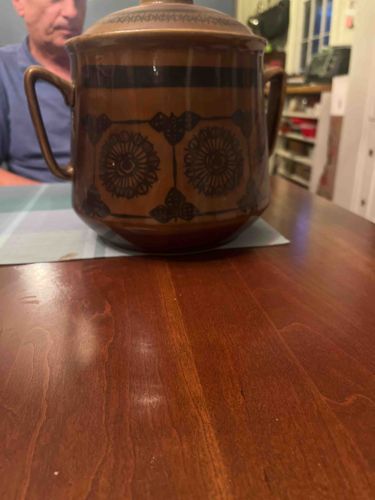
This item is a vintage covered ceramic jar, likely intended for kitchen or serving use, such as a soup tureen or bean pot. It is crafted from glazed ceramic in a warm, medium brown hue, exhibiting a subtle sheen. The jar features a robust, somewhat bulbous body that tapers slightly towards the base. It is equipped with two sturdy, squared-off handles on opposing sides, seamlessly integrated into the body's design. The most striking aesthetic element is the dark brown or black decorative pattern applied to its exterior. This pattern consists of a horizontal band encircling the upper part of the body, just below the rim, and a series of ornate circular motifs accented with detailed floral or symmetrical geometric designs. These circular patterns are interspersed with smaller, leaf-like or abstract shapes, creating a visually rich and repetitive design. The lid, also made of the same brown glazed ceramic, appears to be domed with a small handle or finial on top, although its full detail is partially obscured. There are no immediately visible chips, cracks, or significant damage, suggesting a well-maintained or minimally used condition. The glaze appears consistent, and the decorations are crisp, indicating good manufacturing quality. The overall style suggests a mid-20th century origin, possibly from the 1960s or 1970s, aligning with earthy tones and decorative patterns popular during that period. No specific maker's marks or signatures are discernible from the provided image.
AI Appraisal Report
Upon visual examination of this vintage brown glazed ceramic covered jar, I observe its excellent condition; there are no visible chips, cracks, or significant damage, and the glaze appears consistent and well-preserved. The decorative patterns are crisp, suggesting good manufacturing quality and minimal wear. This piece appears authentic to its described period, likely mid-20th century (1960s-1970s), given its earthy tones and decorative style. However, authenticity cannot be definitively confirmed from images alone; a physical inspection would be necessary to check for maker's marks, assess the ceramic body's specific characteristics, and confirm the glaze's integrity.
In terms of market conditions, similar vintage ceramic tureens or bean pots, even those in good condition, typically fetch modest prices. Comparables indicate that unless there's a strong attribution to a renowned studio potter or a highly collectible manufacturer, demand remains moderate. The design, while attractive, is not exceptionally rare or unique in the broader vintage ceramic market. Factors that would significantly impact value would be a verifiable maker's mark from a sought-after company like McCoy, Haeger, or Hull, or provenance linking it to a notable collection. Without such indicators, its value is primarily driven by its decorative appeal and functional integrity. For full authentication and a more precise valuation, I would require an in-person examination to inspect the base for maker's marks, assess weight and overall craftsmanship firsthand, and potentially perform scientific testing if material composition were in question.