AI estimate as of November 18, 2025 · verify with a professional before acting
AI-Generated · Verify before acting
Everything on this page is generated by AI for informational purposes only. AI can make mistakes — the AI may misidentify items or misattribute them (artist, maker, brand, designer, origin, era). This is not an official valuation and should not be used for insurance, sale, tax, estate, legal, or lending purposes — or any decision requiring a certified appraisal. It is not an authoritative claim about any person, brand, or rights holder — do not share or rely on it as a factual statement about a third party. Always consult qualified professionals before making financial decisions.
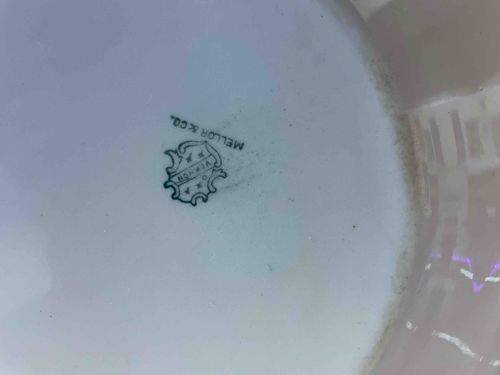
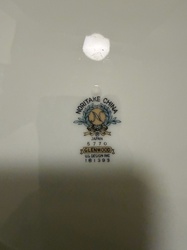
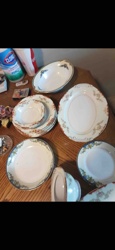
The item depicted is a ceramic dish, identifiable primarily by the prominent manufacturer's mark. The dish appears to be made of white or off-white ceramic material, likely earthenware or porcelain, consistent with common dinnerware and serving pieces. The visible portion of the dish shows a smooth, glazed surface with some signs of age and use. There are subtle reflections on the surface, suggesting a glossy finish. The most distinctive feature is a black transferware backstamp located on what appears to be the underside or bottom surface of the dish. This mark is enclosed within an ornate, shield-like or crest-like design, featuring scrollwork and possibly stars or small geometric motifs within. The text 'MELLOR & CO.' is clearly visible, arcing above the central part of the design, and the word 'VERNON' is inscribed within the shield. This mark indicates manufacture by Mellor & Co., and 'Vernon' likely refers to a specific pattern name or series. The overall condition suggests some wear, with minor discoloration or grime visible along the edges and within the impressed areas of the mark, indicating its age and prior use. There are no immediate signs of chips, cracks, or repairs from the visible area, but a comprehensive assessment would require viewing the entire piece. Based on the style of the mark and general ceramic production, this item likely dates from the late 19th to early 20th century. The craftsmanship appears standard for mass-produced dinnerware of that era.
AI Appraisal Report
I have examined the image of this ceramic dish, identifiable by its Mellor & Co. 'Vernon' pattern backstamp. Visually, the dish appears to be a standard piece of white or off-white ceramic tableware, likely earthenware, from the late 19th to early 20th century. The transferware mark is clear and authentic for Mellor & Co. production. I observe a smooth, glossy surface, with some minor discolorations and grime consistent with age and use, particularly within the impressed areas of the mark and along what appears to be an edge. This indicates a fair to good condition for an item of this vintage, with no obvious chips, cracks, or repairs visible from the provided image.
Market comparables for Mellor & Co. ceramic items, particularly common dinnerware patterns like 'Vernon,' suggest limited demand. While antique, these items are not particularly rare, and many similar pieces from this era by various manufacturers are available in the secondary market. The 'Vernon' pattern itself doesn't typically command premium prices unless it is part of a complete, pristine set or a particularly unusual form. Factors impacting value negatively include the commonality of the pattern and manufacturer, and the piece's likely status as a single, functional tableware item rather than a decorative rarity.
My appraisal is limited by the visual information available. A full authentication and comprehensive condition assessment would require an in-person examination to check for hairline cracks, chips, repairs, crazing, and the overall integrity of the ceramic body. Provenance documentation, though unlikely for such a utilitarian item, could provide historical context but is not expected to significantly impact value. Without a physical inspection, specific details regarding internal damage or restoration remain unknown, which could marginally alter the valuation. Based on current market trends for similar period British ceramic tableware, I estimate this single piece would fetch between $10 and $30.