These notes were written by the person who submitted this item. Appraiser.AI has not verified them, and the AI's identification and estimate may rely on them.
AI Estimated Value
Not an official valuation
$400-600
AI estimate as of November 7, 2025 · verify with a professional before acting
AI-Generated · Verify before acting
Everything on this page is generated by AI for informational purposes only. AI can make mistakes — the AI may misidentify items or misattribute them (artist, maker, brand, designer, origin, era). This is not an official valuation and should not be used for insurance, sale, tax, estate, legal, or lending purposes — or any decision requiring a certified appraisal. It is not an authoritative claim about any person, brand, or rights holder — do not share or rely on it as a factual statement about a third party. Always consult qualified professionals before making financial decisions.
This analysis also relies on unverified notes provided by the user, which may be incomplete or inaccurate and could affect the result.
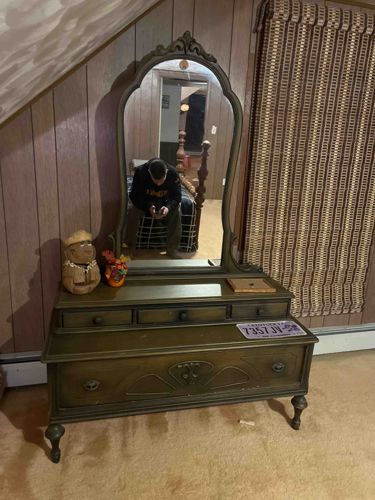
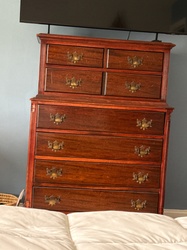
This is a vintage wooden vanity, likely constructed from a dark-stained hardwood, possibly oak or walnut, given its age and common materials used in such furniture. The overall color is a dark, warm brown with visible wood grain, though the finish appears somewhat dulled and could benefit from refinishing. The vanity features a prominent, arched mirror with an ornate, scrolled top crest, suggesting a Victorian or Edwardian influence, or a revival style from the early to mid-20th century. The mirror frame is also made of wood, matching the vanity base. The base of the vanity consists of a central, shallow drawer directly beneath the mirror, flanked by two slightly deeper drawers set to the left and right, forming a recessed knee-hole area where a user would sit. Below these, there is a larger, full-width chest-like compartment with a drop-front or hinged lid, distinguished by a central carved or applied decorative motif, possibly a stylized floral or shell design, with a simple, round Pull handle on either side. The vanity stands on four turned wooden legs that terminate in a bun or squat-ball foot design, characteristic of period furniture. Physical wear includes noticeable scuffing and discoloration on the top surface of the vanity, particularly around the mirror's base and the drawer fronts. The finish exhibits a patina consistent with age and use, with some areas appearing faded or worn through. There are no obvious signs of major damage or repair, though a closer inspection would be needed to confirm. The mirror glass itself appears clear, reflecting the room, but its silvering behind the glass cannot be assessed for deterioration from this image. The quality of craftsmanship appears solid, with hand-carved or applied decorative elements indicating a higher quality of furniture production than mass-produced items.
AI Appraisal Report
Upon visual examination of this vintage wooden vanity, I observe a piece likely crafted from dark-stained hardwood, possibly oak or walnut, exhibiting characteristics of early to mid-20th-century design, potentially influenced by Victorian or Edwardian revival styles. The arched mirror with an ornate, scrolled crest is a prominent feature. The construction, with a central shallow drawer flanked by deeper ones and a larger chest-like compartment below, along with turned legs finishing in bun feet, is consistent with period furniture. The visible wood grain and decorative motif suggest solid craftsmanship. I note noticeable scuffing, discoloration, and a dulled finish, particularly on the top surface and drawer fronts, indicating consistent age and use. The finish has a desirable patina, though some areas appear worn. No major damage or repairs are immediately evident, but this would require closer in-person inspection. The mirror glass appears clear, but silvering condition cannot be assessed from an image.
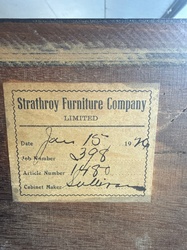
Authenticity verification from images alone has limitations. While the style and wear patterns are consistent with the period, an in-person examination would be crucial to confirm wood type, joinery techniques (dovetails, mortise and tenon), and overall structural integrity, which are key indicators of authenticity and quality. Provenance documentation, if available, would further enhance authentication.
Market conditions for vintage vanities are moderately stable. Pieces with unique carving and solid wood construction like this have a niche appeal among collectors and those furnishing period homes. Demand is moderate, with condition being a significant value driver. Comparables for well-made, unrestored vintage vanities of this style typically range. The current condition, while showing character, necessitates some restoration or refinishing to maximize its aesthetic appeal and value. This factor, along with the lack of definitive in-person verification of construction details, impacts the final appraisal. Given these considerations, a restoration project would likely yield a higher market value.