AI estimate as of October 2, 2025 · verify with a professional before acting
AI-Generated · Verify before acting
Everything on this page is generated by AI for informational purposes only. AI can make mistakes — the AI may misidentify items or misattribute them (artist, maker, brand, designer, origin, era). This is not an official valuation and should not be used for insurance, sale, tax, estate, legal, or lending purposes — or any decision requiring a certified appraisal. It is not an authoritative claim about any person, brand, or rights holder — do not share or rely on it as a factual statement about a third party. Always consult qualified professionals before making financial decisions.
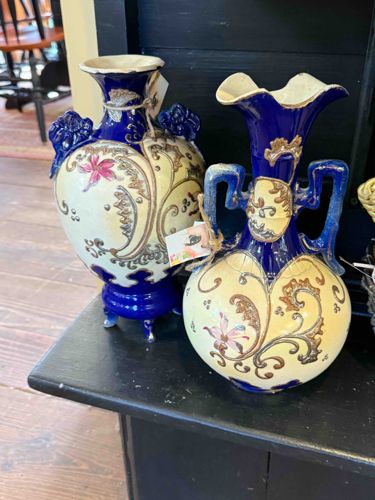
This is a pair of highly decorative ceramic vases, each featuring a predominant color scheme of cobalt blue and cream (or a very light yellow/off-white) with intricate floral and scrollwork designs. The material appears to be glazed ceramic or porcelain. Both vases exhibit hand-painted details, suggesting a certain level of craftsmanship. The taller vase on the left has a bulbous body tapering to a narrower neck and an everted rim. It features two prominent, three-dimensional floral or foliate handles on its shoulders, also painted in cobalt blue. The base of this vase is supported by three small, delicate feet. The body of the vase is primarily cream-colored, adorned with elaborate brown/gold scrollwork and accents, punctuated by pinkish-purple flowers with green leaves. The neck and foot are solid cobalt blue, with some gold detailing around the rim and at the base of the neck. There is visible wear and potential damage, including some chipping or loss of glaze, particularly around the rims and handles, and some signs of age-related crazing. There is a paper tag attached to its neck, indicating it might be part of an inventory from a shop. The shorter vase on the right has a more flared, scalloped neck and body that swells then tapers slightly towards the base. It also features two C-scroll handles, rendered in blue, on its sides. Similar to its counterpart, its main body is cream-colored with analogous brown/gold scrollwork and pinkish-purple floral motifs. The neck and handles are solid cobalt blue, with gold highlights accentuating the decorative elements and rim. Both pieces display a rococo-inspired or Victorian aesthetic, characterized by their ornate designs and color palette. The unevenness in some of the painted details suggests hand application rather than decal. The condition shows significant age and use, with chips, scuffs, and areas of discoloration evident on both pieces, particularly on the blue portions and edges, suggesting an estimated age from the late 19th to early 20th century. The quality of the hand-painting, while decorative, appears to be of a commercial rather than fine art standard.
AI Appraisal Report
I have examined the provided image of this Pair of Decorative Cobalt Blue and Cream Floral Vases. Based on visual inspection, these vases exhibit characteristics of late 19th to early 20th-century decorative ceramic ware. The rococo-inspired, Victorian aesthetic with intricate floral and scrollwork designs, rendered in cobalt blue, cream, and gold accents, aligns with mass-produced ornamental pieces from that period. The hand-painted details, while present, appear to be of commercial quality, not indicative of fine art or master craftsmanship. The overall condition is fair to poor, displaying significant wear consistent with age and use. I note chips, scuffs, crazing, and loss of glaze, particularly on the blue portions and edges. These condition issues significantly impact their marketability and value.
Market conditions for such decorative, non-attributed ceramic vases are relatively soft. While they offer a certain antique charm, they lack the provenance, artist attribution, or exceptional quality that would drive higher demand. Comparables in similar condition typically fetch modest prices at auction or in secondary markets. Rarity is not a significant factor here; similar styles were widely produced.
Limitations: My assessment is based solely on visual examination of the provided image. To fully authenticate and assess these items, a physical inspection would be crucial. I would need to examine the ceramic body for maker's marks or factory stamps, assess the quality of the glaze and painting firsthand, and thoroughly document all condition issues. Scientific testing could determine the exact age and composition of the ceramic and paints, but this is generally not cost-effective for items in this price range. Without this, I cannot definitively rule out later reproductions or precise origin.