AI estimate as of August 17, 2025 · verify with a professional before acting
AI-Generated · Verify before acting
Everything on this page is generated by AI for informational purposes only. AI can make mistakes — the AI may misidentify items or misattribute them (artist, maker, brand, designer, origin, era). This is not an official valuation and should not be used for insurance, sale, tax, estate, legal, or lending purposes — or any decision requiring a certified appraisal. It is not an authoritative claim about any person, brand, or rights holder — do not share or rely on it as a factual statement about a third party. Always consult qualified professionals before making financial decisions.
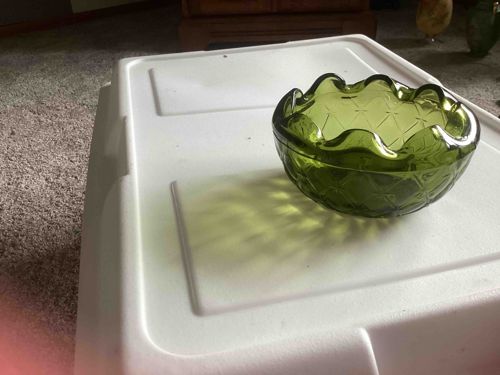
The item is a small, round bowl crafted from dark olive-green glass. Its most distinctive feature is the heavily scalloped or ruffled rim, which adds a decorative flair to the piece. The body of the bowl is adorned with a raised, diamond or criss-cross pattern, giving it a textural and reflective quality. This pattern is consistent around the entire exterior of the bowl, suggesting it was molded. The glass appears to be pressed rather than hand-blown, indicating mass production. The size of the bowl suggests it could function as a candy dish, trinket holder, or a small decorative accent piece. There are no readily visible chips, cracks, or significant damage to the glass, suggesting it is in good overall condition. The surface exhibits a clean, smooth finish, typical of glass that has been well-maintained. The dark green color and specific pattern are characteristic of glassware from the mid-20th century, likely dating to the 1950s or 1960s, a period when colored pressed glass was popular. No maker's marks or signatures are discernible from the image. The overall craftsmanship suggests a commercially produced item, not a one-of-a-kind artisan piece, but its robust construction and decorative details point to a good quality pressed glass item designed for everyday use or aesthetic display.
AI Appraisal Report
I have carefully examined the provided image of the Olive Green Scalloped Diamond Pattern Glass Bowl. Based on visual assessment, the bowl appears to be in very good overall condition, showing no readily visible chips, cracks, or significant damage. The clean, smooth surface indicates it has been well-maintained. The construction, with its raised diamond pattern and heavily scalloped rim, strongly suggests it is a piece of pressed glass, typical of mass production rather than hand-blown artisan work. This aligns with characteristics seen in decorative glassware from the mid-20th century, likely the 1950s or 1960s, a period when colored pressed glass was widely popular. Its dark olive-green hue is a common color for this era.
In terms of market conditions, items of this nature fall into the broad category of decorative vintage glassware. While charming and visually appealing, this specific type of pressed glass is not rare. Similar pieces from various manufacturers circulate frequently in secondary markets, including online platforms, antique malls, and estate sales. Demand for general decorative pressed glassware is modest; typically, only pieces from highly collectible manufacturers (e.g., Fenton, Imperial, Duncan & Miller) or unusual patterns/colors command higher prices, especially if they are part of a larger set or rare form. This bowl, lacking discernible maker's marks or a unique design that would elevate it above common production, falls into the more accessible segment of vintage glassware.
Factors significantly impacting value are primarily its condition—which is excellent—and its appealing color and decorative pattern. However, the lack of a known maker or unique features limits its collectible value. Without an in-person examination, I cannot verify the absence of hairline cracks, internal fractures, or minute flea bites that might not be visible in the image. Furthermore, provenance documentation would be needed for a definitive authenticity claim regarding its precise age or manufacturer, though the style strongly points to mid-century pressed glass. Scientific testing is not typically applied to items of this value unless there are significant authenticity concerns regarding material composition, which is not the case here.
Considering current market trends for vintage pressed glass of this type, which is decorative but not rare or from a highly sought-after maker, its value is primarily decorative.