AI estimate as of July 12, 2025 · verify with a professional before acting
AI-Generated · Verify before acting
Everything on this page is generated by AI for informational purposes only. AI can make mistakes — the AI may misidentify items or misattribute them (artist, maker, brand, designer, origin, era). This is not an official valuation and should not be used for insurance, sale, tax, estate, legal, or lending purposes — or any decision requiring a certified appraisal. It is not an authoritative claim about any person, brand, or rights holder — do not share or rely on it as a factual statement about a third party. Always consult qualified professionals before making financial decisions.
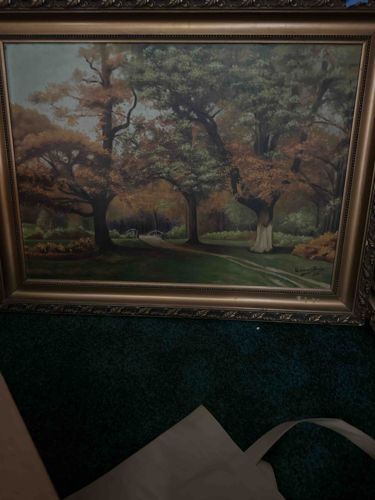
This item is an oil painting depicting a lush forest scene, likely in autumn, given the prominent display of trees with foliage varying from green to warm oranges and browns. The painting is encased in an ornate, gilded wooden frame. The frame features intricate molded details, suggesting a traditional or classical aesthetic. The artwork itself appears to be painted on a canvas or board, with visible brushstrokes indicating an impressionistic or realistic style. The foreground shows a grassy path or clearing with what appears to be a white structure, possibly a small bridge or garden feature, nestled among the trees on the left side, and a distinct white band around the base of one of the central trees. Two distinct, unpaved tracks or ruts are visible on the path leading into the depth of the painting, adding a sense of perspective. The overall color palette is rich, with deep greens, earthy browns, and a sky rendered in lighter blue-grey tones. The visible condition suggests some age, with a possible slight dulling of colors or accumulation of surface dirt, though no significant damage like tears or major paint loss is immediately apparent through the image. The craftsmanship of the painting appears competent, with attention paid to light and shadow, and the details of the foliage and tree trunks. There is a visible signature in the lower right corner, although it is not clearly legible from the provided image. The style and framing suggest it could be a piece from the mid-20th century or earlier, though precise dating would require further examination of the artist's signature and oeuvre. The gilded frame itself contributes to the antique aesthetic of the piece.
AI Appraisal Report
Upon visual examination of this Autumn Forest Landscape Oil Painting in an Ornate Gilded Frame, I assess its condition as good, commensurate with age. There are no overt signs of significant damage like tears or paint loss, though some surface grime and slight dulling of colors are perceptible, which are typical for an older oil painting. The ornate gilded frame is intact, complementing the artwork's aesthetic. Authenticity of the artwork itself, beyond the general style, cannot be definitively confirmed from images alone. A visible signature is present in the lower right, but its legibility is poor; in-person examination, comparison with known artist signatures, or provenance documentation would be crucial for artist attribution.
Market conditions for traditional landscape oil paintings of this type are generally stable, with demand often driven by decorative appeal rather than investment potential, unless attributed to a well-known artist. Comparables in this aesthetic typically range widely depending on artist, size, and specific visual appeal. The craftsmanship appears competent, with good attention to light, shadow, and detail, suggesting a skilled (though possibly amateur or local) hand. Rarity is difficult to assess without artist identification; general landscape paintings are not inherently rare. Factors impacting value significantly include the lack of a clearly identifiable artist, which limits the potential for higher market prices. Should the signature be identifiable as a listed artist, the value would increase substantially. Without such identification, this piece functions primarily as a decorative antique. A physical inspection would allow for closer examination of brushwork, pigment, canvas condition, and frame integrity, which could further refine the appraisal. Scientific testing (e.g., pigment analysis) would be necessary for precise dating and authenticity verification beyond visual cues.