AI Appraisal Estimate

AI-generated estimates · not official valuations

From the user

What was submitted

Photo and notes provided by the user — not generated by AI

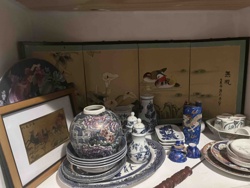
Submitted item photo
Submitted photo · June 8, 2026

User's notes

No additional notes provided.

AI analysis below

AI appraisal

AI analysis & estimate

AI-Generated · Verify before acting

Everything below is generated by AI for informational purposes only. AI can make mistakes — the AI may misidentify items or misattribute them (artist, maker, brand, designer, origin, era). This is not an official valuation and should not be used for insurance, sale, tax, estate, legal, or lending purposes — or any decision requiring a certified appraisal. It is not an authoritative claim about any person, brand, or rights holder — do not share or rely on it as a factual statement about a third party. Always consult qualified professionals before making financial decisions.

Read the full disclaimer

AI Identification

·Not independently authenticated·Verify before acting

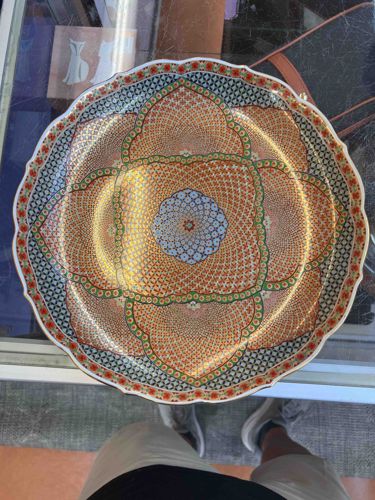
Japanese Satsuma-Style Thousand Flower Scalloped Charger

Asian Antiques / Ceramics and Porcelain

AI Estimated Value

·Not an official valuation·Verify before acting

$800.00 - $1,200.00

As of June 8, 2026

AI Item Analysis

·AI can make mistakes·Verify before acting
This is a highly ornate ceramic charger plate, specifically a 'Thousand Flower' (Millefleurs) design typical of Japanese Satsuma or Kutani ware styles. The piece features a scalloped, bracketed rim and is characterized by its incredibly dense, polychrome overglaze enamel decoration. The central composition uses a complex geometric 'petal' or lobed framework that radiates from a central floral rosette. The primary color palette consists of a rich coral-orange, forest green, turquoise, and black, with significant gold gilt highlighting throughout the intricate diaper patterns and floral motifs. The construction appears to be a heavy white-bodied ceramic or porcelain. The craftsmanship is of a high technical standard, showcasing the 'kinrande' (gold brocade) style where gold leaf or powder is applied over the glaze to create texture and light reflection. The repetitive, microscopic patterns suggest a late 19th-century Meiji era influence or a high-quality 20th-century revival. Visible condition appears overall excellent with no large cracks or chips evident from the top view, though some minor gilt rubbing on the raised scalloped edges and surface micro-scratches consistent with its age and use as a display piece may be present upon close physical inspection. No maker's mark is visible on the front, but one would typically be found centered on the reverse.
AI Appraisal Report

·AI can make mistakes·Verify before acting
I have virtually examined this Japanese 'Thousand Flower' (Millefleurs) scalloped charger. The piece displays the high-level technical proficiency associated with late Meiji Period (1868–1912) craftsmanship or early 20th-century Taisho-era revival periods. The overglaze enamels are vibrant, particularly the iron-red (benigara) and malachite greens, which are applied with a density that suggests a high-quality workshop production. The extensive use of 'kinrande' (gold brocade) detailing is well-preserved, though slight thinning of the gilt on the scalloped 'bracket' edges indicates honest age-related handling. The current market for Japanese ceramics remains selective. While standard Satsuma export ware has seen a price correction, 'Thousand Flower' motifs—valued for their labor-intensive execution—retain strong demand among collectors of Asian decorative arts. Comparables for plates of this size and density typically hammer between $700 and $1,500 at specialized auction houses. The lack of visible 'crazing' (often found in Satsuma) suggests a harder porcelain body, potentially pointing toward a Kutani-influenced workshop. Limitations: This appraisal is based solely on digital imagery. A definitive valuation is hindered by the lack of a reverse-side view, which would typically reveal a kizu (mark) or kiln scars essential for identifying specific artists or kilns (e.g., Kinkozan or Yabu Meizan). To fully authenticate this as a Meiji-era masterpiece rather than a high-quality mid-20th-century reproduction, I would require an in-person macroscopic inspection of the glaze's depth and any documented provenance or original 'tomobako' (wooden storage box). Scientific testing like thermoluminescence is rarely used for Meiji porcelain but could be employed if the piece were suspected to be much older.

Get your items appraised

Instant estimates of your treasures with AI-powered appraisals

Browse More Appraisals