AI estimate as of September 24, 2025 · verify with a professional before acting
AI-Generated · Verify before acting
Everything on this page is generated by AI for informational purposes only. AI can make mistakes — the AI may misidentify items or misattribute them (artist, maker, brand, designer, origin, era). This is not an official valuation and should not be used for insurance, sale, tax, estate, legal, or lending purposes — or any decision requiring a certified appraisal. It is not an authoritative claim about any person, brand, or rights holder — do not share or rely on it as a factual statement about a third party. Always consult qualified professionals before making financial decisions.
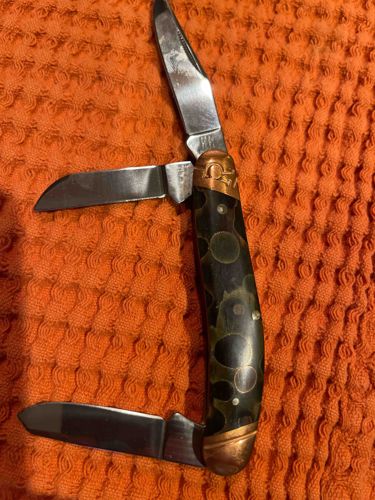
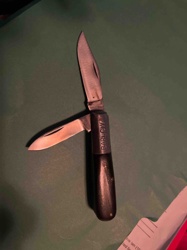
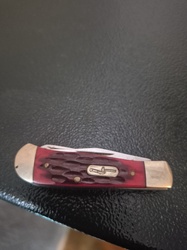
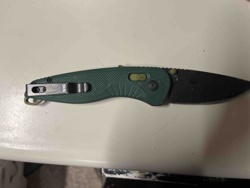
This is a multi-blade folding pocket knife, featuring three distinct blades deployed from a single handle. The handle exhibits a striking mottled or 'spotted' pattern, primarily in dark green and black hues with lighter green/tan circular or oval-shaped inclusions, suggesting a resin, celluloid, or possibly a natural material like certain forms of horn or bone. The handle scales are secured by small, metallic pins, likely brass or nickel silver, visible on the surface. The knife features bolster plates at both ends of the handle, which appear to be made of brass or copper, showing a noticeable patina or tarnish that indicates age and handling. The top bolster has an embossed or engraved symbol, which resembles a stylized 'Ω' (Omega) or a similar intricate design, adding a unique distinguishing element. The three blades are all made of polished metal, likely stainless steel or carbon steel, and show signs of wear and use, including scratches, scuffs, and some dulling on the cutting edges. One larger clip-point blade is prominently displayed, along with a smaller clip-point blade and what appears to be a smaller pen or coping blade. The overall construction suggests a traditionally styled pocket knife. The visible condition issues include surface wear on the blades, tarnish on the brass bolsters, and general signs of use consistent with an older, functional tool rather than a display piece. The craftsmanship, particularly the detailed handle and the visible bolster embellishment, suggests a quality piece, possibly vintage, though specific manufacturing marks are not clearly discernible in the image. The age is estimated to be mid-20th century to late 20th century based on style and observed wear.
AI Appraisal Report
Upon visual examination of this Multi-Blade Folding Pocket Knife with the distinct spotted handle, I assess it to be an authentic vintage or antique pocket knife. The three-blade configuration, spotted handle material (likely celluloid or a similar synthetic given the pattern uniformity), and the tarnished brass bolsters with the embossed Ω-like symbol strongly suggest a product from the mid to late 20th century. The condition, showing significant wear on the blades (scratches, dulling) and bolster patina, indicates regular use rather than being a display piece. This wear is consistent with its age and function.
Market conditions for multi-blade pocket knives of this type are generally stable, with demand driven by collectors of vintage tools and everyday carry enthusiasts. While not exceedingly rare, the unique handle pattern and the bolster engraving add a degree of collectibility. Comparables include vintage Camillus, Schrade, or similar manufacturers' multi-blade knives from the same era. Factors impacting value include the visible wear and tear, which reduces the 'mint' appeal, but the intact handle scales and functional appearance maintain its intrinsic value. The lack of clear manufacturer markings prevents attribution to a specific, highly coveted maker, which would otherwise significantly increase its value.
Limitations in authenticity verification from images alone are notable. Without physical inspection, I cannot confirm the exact material of the handle (e.g., celluloid vs. horn), nor can I ascertain the steel type of the blades. Furthermore, the functionality of the blade locks/springs, the sharpness, and the presence of any hidden maker’s marks cannot be confirmed. A physical examination would allow for tactile assessment of materials, full inspection for maker's marks, and evaluation of blade freedom of movement and locking mechanisms. Provenance documentation, if available, would provide invaluable historical context and attribution. Scientific testing is not typically required for knives of this nature unless there were specific questions regarding elemental composition.