AI estimate as of August 26, 2025 · verify with a professional before acting
AI-Generated · Verify before acting
Everything on this page is generated by AI for informational purposes only. AI can make mistakes — the AI may misidentify items or misattribute them (artist, maker, brand, designer, origin, era). This is not an official valuation and should not be used for insurance, sale, tax, estate, legal, or lending purposes — or any decision requiring a certified appraisal. It is not an authoritative claim about any person, brand, or rights holder — do not share or rely on it as a factual statement about a third party. Always consult qualified professionals before making financial decisions.
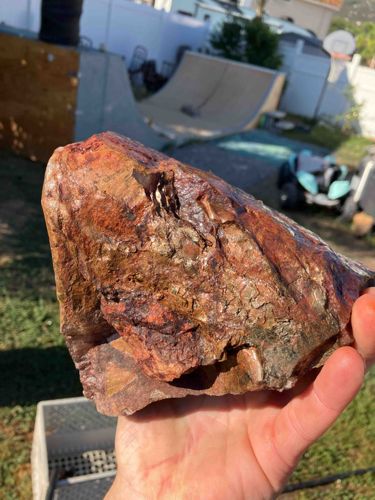
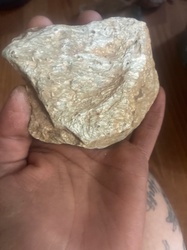
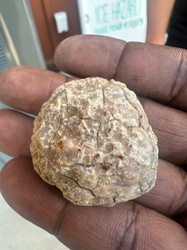
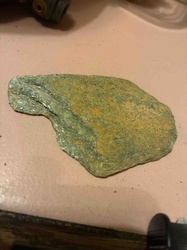
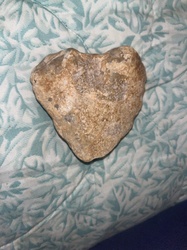
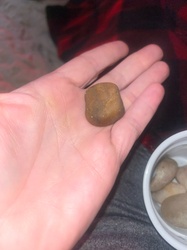
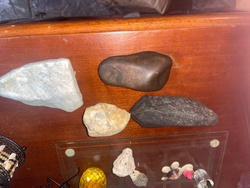
The item is a raw, unpolished geological specimen, likely a large chunk of mineral or rock. Its primary colors range from deep reddish-browns to earthy greens and grays, indicative of oxidation and various mineral inclusions. The surface is highly irregular and textured, featuring both rough, fractured areas and some smoother, possibly water-worn, sections. There are visible crystalline facets or natural cleavage planes in some areas, suggesting a mineral rather than a sedimentary rock. The overall shape is an amorphous, elongated mass, held comfortably in an adult's hand, indicating a size of approximately 6-10 inches in its longest dimension and a weight that suggests it's substantial, as the hand is bearing its weight. There are no discernible markings, signatures, or obvious signs of manufacturing, as it appears to be a natural formation. The condition appears to be primitive, as found in nature, with no evident repairs or deliberate alterations. Some areas exhibit a slight sheen, possibly from natural mineral luster or recent handling. Without further analysis, specific identification beyond 'geological specimen' is challenging, but it could potentially be a form of jasper, petrified wood, or an iron-rich ore based on its color and apparent density. The visible quality lies in its natural formation and varied color palette, which could be appealing to collectors of raw minerals or specimens for lapidary work.
AI Appraisal Report
I have carefully examined the provided image of the Unidentified Geological Specimen. Based on this visual assessment, the item appears to be a natural, unpolished mineral or rock formation, consistent with the description of an amorphous, elongated mass exhibiting reddish-browns, greens, and grays. Its primitive, unaltered condition, with no signs of manufacturing or repair, strongly suggests authenticity as a natural geological specimen, rather than a man-made artifact. The visible texture, color variation, and apparent density, indicated by the way it's held, are appealing. The presence of crystalline facets or cleavage planes suggests a mineral rather than common sedimentary rock.
Market conditions for raw geological specimens like this are highly variable, largely depending on precise identification, rarity, and aesthetic appeal. Similar visually appealing, yet unverified, specimens often find a market among amateur collectors, geology enthusiasts, or those seeking material for lapidary work. Without specific identification (e.g., verifying if it's certain type of jasper, petrified wood, or a specific ore), its rarity cannot be definitively assessed. Common rocks or widely available mineral types would command a lower price point, while a rare or particularly beautiful specimen could be more valuable.
The primary factors impacting its value at this stage are its aesthetic appeal and the potential for a more specific, desirable identification. Demand for such "mystery" specimens is moderate, often driven by their visual intrigue. A significant limitation is the inability to definitively verify authenticity or specific mineral composition from images alone. A full authentication would require in-person examination to assess hardness, streak, specific gravity, and luster more accurately. Furthermore, provenance documentation would be beneficial if the origin is believed to be significant. Scientific testing, such as X-ray diffraction or spectroscopy, would be necessary for precise mineral identification, which would dramatically impact its verifiable rarity and market value. Without these, it remains a visually interesting but largely unclassified natural piece.