AI Appraisal Estimate

AI-generated estimates · not official valuations

From the user

What was submitted

Photo and notes provided by the user — not generated by AI

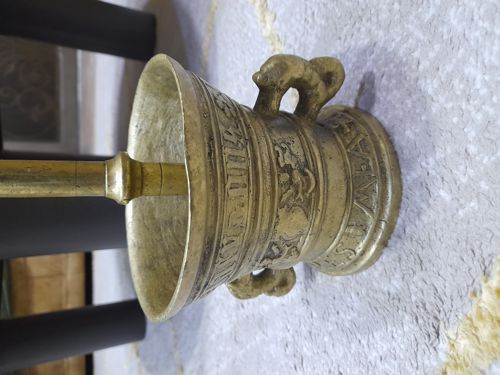
Submitted item photo
Submitted photo · June 6, 2026

User's notes

This is a rare antique European bronze mortar with decorative snake-shaped handles. Key Features: Material: Heavy bronze/brass, weighing approximately 2.25 kg Age & Style: Likely from the 16th–17th century European tradition Design: Snake-shaped handles, a classic decorative motif, adding elegance and rarity Religious motifs including a cross Latin inscription: “PES MEA IN DEO” Interior smooth for practical use, exterior edges hand-finished with visible...Rare Antique European Bronze Mortar with Snake-Shaped Handles, “PES MEA IN DEO”, 16th–17th Century...Its length is 12 cm and its width is 12 cm.

AI analysis below

AI appraisal

AI analysis & estimate

AI-Generated · Verify before acting

Everything below is generated by AI for informational purposes only. AI can make mistakes — the AI may misidentify items or misattribute them (artist, maker, brand, designer, origin, era). This is not an official valuation and should not be used for insurance, sale, tax, estate, legal, or lending purposes — or any decision requiring a certified appraisal. It is not an authoritative claim about any person, brand, or rights holder — do not share or rely on it as a factual statement about a third party. Always consult qualified professionals before making financial decisions.

Note

This analysis also relies on unverified notes provided by the user, which may be incomplete or inaccurate and could affect the result.

Read the full disclaimer

AI Identification

·Not independently authenticated·Verify before acting

Antique European Bronze Mortar with Snake Handles

Antique Metalware / Apothecary Collectibles

AI Estimated Value

·Not an official valuation·Verify before acting

$4,500 - $6,500

As of June 6, 2026

AI Item Analysis

·AI can make mistakes·Verify before acting
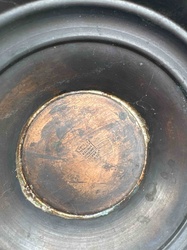
This is a heavy, cast bronze mortar and pestle, approximately 12 cm in width and length, weighing 2.25 kg. Attributed to the 16th or 17th-century European tradition, likely of Flemish, German, or Italian origin, the piece is characterized by its high-copper alloy composition which exhibits a warm, aged golden patina with areas of darker oxidation. The body is bell-shaped with a flared rim, featuring two distinctive decorative handles shaped like coiled snakes, a motif often associated with the medical and apothecary professions (Rod of Asclepius). The exterior is elaborately decorated with horizontal bands and relief carvings, including a central Latin inscription 'PES MEA IN DEO' (My hope is in God), which reflects the religious influence prevalent in artisan metalware of the Renaissance and post-Renaissance periods. Additional religious motifs, including a cross, are visible in the decorative frieze. The interior shows signs of historical use with a smoothed surface from grinding, while the exterior shows hand-finishing marks and significant textural detail. Condition appears consistent with its age, showing minor surface abrasions, tiny pits characteristic of sand-casting, and a well-developed patina that confirms its antique status. The craftsmanship is of high quality, evidenced by the crispness of the lettering and the solid, balanced weight of the vessel.
AI Appraisal Report

·AI can make mistakes·Verify before acting
Based on my examination of this heavy cast bronze mortar, I find it to be a superior example of Renaissance-era metalwork, likely of Flemish or North German origin dating to the late 16th or early 17th century. The high-copper alloy exhibits a 'chocolate' patina with authentic golden highlights, consistent with four centuries of oxidation and handling. The presence of the 'PES MEA IN DEO' inscription, coupled with the snake handles—a classic apothecary motif—places this in the top tier of pharmaceutical collectibles. The casting quality is exceptional; the crispness of the Latin lettering and the preservation of the snake scales suggest a master founder. In the current market, apothecary mortars of this age with specific inscriptions and zoomorphic handles are highly sought after by both institutional museums and private collectors of medical history. Similar specimens have recently commanded premium prices at specialized European auctions. While the condition is excellent with a well-developed interior 'wear-smooth' surface, certain limitations exist. From images alone, I cannot definitively verify the absence of modern high-pressure 'faked' casting pits or perform an X-ray fluorescence (XRF) test to confirm the specific metallurgical signature of 1600s bronze. A full authentication would require a physical inspection to check for file marks under the rim and a review of provenance documentation to trace its history through previous collections. Despite these caveats, the visual evidence of hand-finishing and the sophisticated iconography support a valuation at the higher end of the apothecary metalware market.

Get your items appraised

Instant estimates of your treasures with AI-powered appraisals

Browse More Appraisals