AI estimate as of September 23, 2025 · verify with a professional before acting
AI-Generated · Verify before acting
Everything on this page is generated by AI for informational purposes only. AI can make mistakes — the AI may misidentify items or misattribute them (artist, maker, brand, designer, origin, era). This is not an official valuation and should not be used for insurance, sale, tax, estate, legal, or lending purposes — or any decision requiring a certified appraisal. It is not an authoritative claim about any person, brand, or rights holder — do not share or rely on it as a factual statement about a third party. Always consult qualified professionals before making financial decisions.
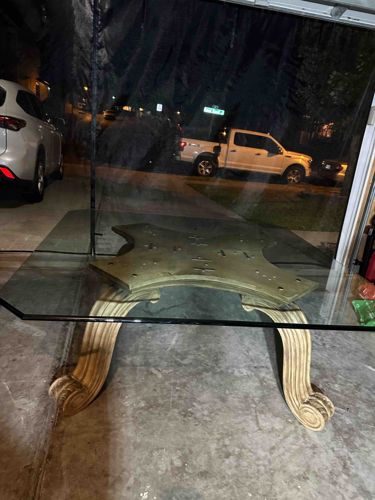
This is a coffee table characterized by a clear glass top supported by a central base composed of two intricately carved, curved legs. The glass top appears to be a thick, rectangular slab with beveled or polished edges, suggesting quality craftsmanship. Its transparency allows the underlying decorative base to be fully visible. The base itself is a prominent feature, consisting of two substantial, S-curve shaped legs, each adorned with vertical fluting that terminates in a scrolled volute at the floor level. The material of the legs appears to be wood, possibly a lighter-colored hardwood, finished with a distressed or antiqued cream/light beige paint or wash, giving it a somewhat aged aesthetic. Connecting these two legs at the top is a central, horizontal support structure, also in a similar finish, which provides the anchor for the glass top. This central piece has an ornate, somewhat scalloped or stylized shape. The construction seems robust, indicating a piece designed for stability, typical of a coffee table. There are no immediately visible major damages such as cracks in the glass or significant breaks in the wooden base, although general wear commensurate with age and use (e.g., minor scuffs on the base finish, fingerprints on the glass) can be anticipated. The design elements, specifically the fluted legs and scrolled feet, point towards a Neoclassical or Empire style influence, suggesting an estimated age from the late 20th century, possibly earlier if it's a true antique or high-quality reproduction. The quality of the carving and the substantial nature of the components indicate a well-made piece of furniture.
AI Appraisal Report
Based on my visual examination of the provided image, this Neoclassical Style Glass Top Coffee Table with Fluted Legs presents as a well-crafted piece. The clear glass top appears thick with finished edges, suggesting good quality. The most distinctive feature is the central base with two S-curve fluted legs terminating in scrolled volutes, finished in an antiqued cream/light beige. The substantial nature of the components and the detailing on the legs, particularly the fluting, align with Neoclassical or Empire influences. The overall condition appears good, with no obvious signs of major damage such as chips, cracks, or significant breaks. I would anticipate general wear commensurate with age, such as minor scuffs to the painted finish or surface wear on the glass, which is typical for a used furniture piece.
From a market perspective, this style maintains consistent demand, particularly for well-executed reproductions or pieces from the late 20th century. Comparables for such pieces, often found in designer used furniture markets or online platforms, typically fall within this range. While not exceedingly rare, the quality of the carving and the robust construction elevate its appeal beyond mass-produced items. The aesthetic allows it to blend into various decorative schemes, enhancing its marketability.
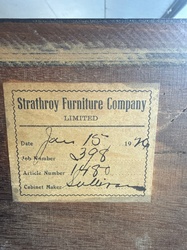
Limitations in authenticity verification from images alone are notable. Without a physical inspection, it is impossible to confirm the wood species, the exact manufacturing techniques (e.g., joinery), or the age definitively. An in-person examination would allow me to assess the quality of the glass more closely, detect any subtle repairs, and more accurately gauge the true age by examining the patina, construction methods, and manufacturing labels if present. Provenance documentation could also support claims of origin or historical significance. Without these, my assessment of its age and originality remains an estimate based on stylistic cues and perceived quality.