These notes were written by the person who submitted this item. Appraiser.AI has not verified them, and the AI's identification and estimate may rely on them.
AI Estimated Value
Not an official valuation
$75 - $150
AI estimate as of August 28, 2025 · verify with a professional before acting
AI-Generated · Verify before acting
Everything on this page is generated by AI for informational purposes only. AI can make mistakes — the AI may misidentify items or misattribute them (artist, maker, brand, designer, origin, era). This is not an official valuation and should not be used for insurance, sale, tax, estate, legal, or lending purposes — or any decision requiring a certified appraisal. It is not an authoritative claim about any person, brand, or rights holder — do not share or rely on it as a factual statement about a third party. Always consult qualified professionals before making financial decisions.
This analysis also relies on unverified notes provided by the user, which may be incomplete or inaccurate and could affect the result.
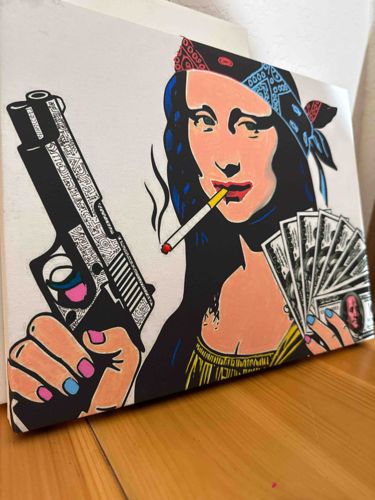
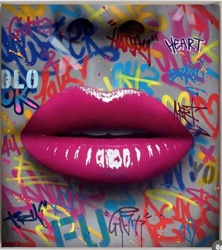
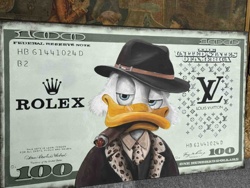
This item is a canvas art print, likely reproduced, featuring a satirical and modern interpretation of Leonardo da Vinci's Mona Lisa. The physical characteristics indicate it is a rectangular canvas stretched over a frame, with visible edges suggesting a standard gallery wrap. The color palette is vibrant and bold, typical of pop art, utilizing stark contrasts of black, white, peach tones for skin, a strong red for lips, various blues for the bandana and hair, and pinks/blues for nail polish. The 'Mona Lisa' character is depicted with a contemporary 'gangster' or 'rebel' aesthetic, wearing a blue bandana with white and red patterns, holding a detailed black handgun in one hand with a pink and blue manicure, and fanning out several hundred-dollar bills (with what appears to be Benjamin Franklin's portrait visible on one) in the other. She also has a lit cigarette dangling from her mouth, exhaling smoke, and is shown with long dark hair and a gold, fringed garment as a top. The handgun features intricate, almost tribal-like, white patterning on its frame. The style is distinctly pop art, characterized by its graphic, comic-book-like outlines and flat areas of color. The artwork appears to be in excellent condition with no discernible damage, wear, or fading visible from the image. Its quality is indicated by the crisp lines and vibrant color saturation, suggesting a well-produced print. No specific artist's signature or maker's mark is visible in the provided image; however, such pieces are often adaptations of well-known pop art styles and are likely post-2000 given the contemporary nature of the satire.
AI Appraisal Report
Upon examining the provided image of the 'Mona Lisa Gangster' Pop Art Canvas Print, I assess its condition as excellent. The colors are vibrant, lines crisp, and there are no visible signs of damage, wear, or fading. This suggests a high-quality reproduction.
Authenticity, however, is a key consideration. While the pop art style is clear, verifying this as an original artwork by a known artist, or even a limited-edition print, is impossible from an image alone. These types of satirical pop art prints, often featuring iconic figures reimagined, are widely reproduced and sold by various online retailers and art aggregators. The lack of a visible signature or maker's mark further limits definitive authentication via image.
In terms of market conditions, the demand for contemporary pop art, especially satirical pieces, remains steady. However, the market is saturated with similar mass-produced prints. Comparables for such unauthenticated, unsigned canvas prints typically range from $50 to $200, depending on size, print quality, and specific vendor. Rare, signed, or limited-edition prints by established pop artists would command significantly higher values, but this piece does not present itself as such.
The rarity of this specific print is low; countless variations of pop art Mona Lisa interpretations exist. Its value is primarily driven by its aesthetic appeal as a decorative item rather than its artistic provenance or scarcity. Factors significantly impacting value include the potential for it to be an original work by a named artist, its edition number (if part of a limited run), or significant provenance documenting its history.
For full authentication, an in-person examination is crucial to assess texture, print quality, and the presence of hidden marks. Provenance documentation (e.g., certificate of authenticity, purchase receipts) and, if claimed to be an original, scientific testing (e.g., pigment analysis) would be essential to move beyond the current appraisal based solely on its visual decorative value.