AI estimate as of November 30, 2025 · verify with a professional before acting
AI-Generated · Verify before acting
Everything on this page is generated by AI for informational purposes only. AI can make mistakes — the AI may misidentify items or misattribute them (artist, maker, brand, designer, origin, era). This is not an official valuation and should not be used for insurance, sale, tax, estate, legal, or lending purposes — or any decision requiring a certified appraisal. It is not an authoritative claim about any person, brand, or rights holder — do not share or rely on it as a factual statement about a third party. Always consult qualified professionals before making financial decisions.
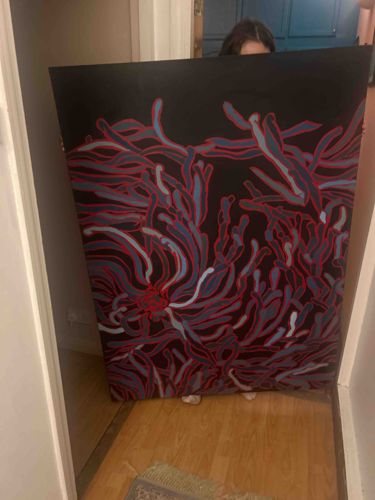
This appears to be a contemporary abstract painting, depicting what resembles underwater flora such as coral or sea anemones. The medium is likely acrylic or oil paint on canvas, stretched over a wooden frame, given its rigid, rectangular form. The dominant colors are a dark, possibly black or very deep navy, background with vibrant red, muted blue (reminiscent of periwinkle or slate), and white outlines forming organic, flowing shapes. The composition is highly dynamic, featuring numerous elongated, serpentine forms that intertwine and overlap, creating a sense of natural movement. A central cluster of these forms at the bottom center of the painting suggests a focal point, with a more intricate arrangement of red and blue lines radiating outwards. The lines defining the shapes often have a secondary, thinner outline in a contrasting color (e.g., red forms outlined in blue, or blue forms outlined in red or white), adding depth and visual texture. The brushwork appears bold and graphic, emphasizing the outlines rather than subtle blending or shading within the forms. There are no visible condition issues such as tears, cracks, or significant wear, and the colors appear vibrant. Without a closer inspection or detail shots, distinguishing manufacturing marks or an artist's signature is not possible. The style is distinctly abstract and contemporary, likely dating from the late 20th century to the present day. The craftsmanship appears clean and deliberate, with consistent line work throughout the piece, suggesting a practiced hand.
AI Appraisal Report
I have examined the provided image of this abstract painting depicting coral or anemone-like forms. Based on visual assessment, the condition appears excellent; I observe no tears, cracks, significant wear, or fading. The colors are vibrant, suggesting good preservation. Authenticity, based solely on this image, refers to it being a genuine painting rather than a print. The brushwork and visual texture support it being an original piece, likely acrylic or oil on canvas.
Market conditions for contemporary abstract art featuring marine-inspired motifs are generally stable, with a broad appeal for decorative purposes. Comparable works by emerging or lesser-known contemporary artists, particularly unsigned pieces, typically fall within a modest price range. The demand for such pieces is often driven by aesthetic appeal for interior design rather than significant artistic provenance. While visually striking, the style does not immediately suggest a highly collectible or rare artist, which typically commands higher prices. The absence of a visible signature significantly impacts its value, as artist identification is crucial for establishing provenance and market history.
Factors significantly influencing value include the lack of an identifiable artist and the absence of provenance. If this piece were by a recognized artist, even a contemporary one, its value would increase considerably. Without the artist's identity, it primarily functions as a decorative art piece.
My primary limitation in this appraisal is the lack of physical examination. A hands-on inspection would allow me to verify the paint medium definitively, check for any subtle surface imperfections, and search for a discreet signature or date that might not be visible in the image. Provenance documentation, such as purchase receipts or exhibition history, would be essential for full authentication and to potentially link it to a specific artist, thus allowing for a more precise valuation.