These notes were written by the person who submitted this item. Appraiser.AI has not verified them, and the AI's identification and estimate may rely on them.
AI Estimated Value
Not an official valuation
$1-3
AI estimate as of July 7, 2025 · verify with a professional before acting
AI-Generated · Verify before acting
Everything on this page is generated by AI for informational purposes only. AI can make mistakes — the AI may misidentify items or misattribute them (artist, maker, brand, designer, origin, era). This is not an official valuation and should not be used for insurance, sale, tax, estate, legal, or lending purposes — or any decision requiring a certified appraisal. It is not an authoritative claim about any person, brand, or rights holder — do not share or rely on it as a factual statement about a third party. Always consult qualified professionals before making financial decisions.
This analysis also relies on unverified notes provided by the user, which may be incomplete or inaccurate and could affect the result.
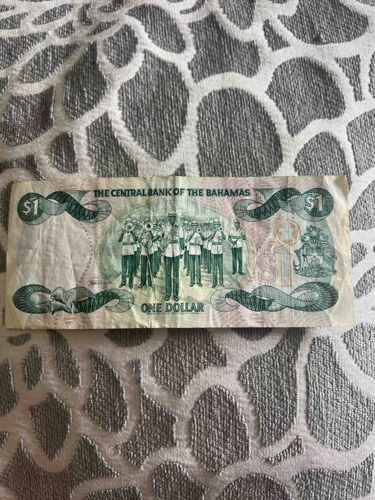
This item is a Bahamian One Dollar banknote, featuring a design typical of mid to late 20th-century currency. The note is primarily green and white, with accents of yellow or cream visible in the paper itself, suggesting age and handling. The physical characteristics indicate a standard banknote size, made from a paper substrate, likely a cotton-linen blend common for currency, which allows for durability and intricate printing. The overall condition shows signs of significant circulation, with visible creases, folds, and general wear throughout the surface. The corners appear softened and slightly frayed, and the edges exhibit minor nicks and folds. There's a subtle discoloration or patina across the note, consistent with age and exposure. A prominent feature on this side of the note (likely the reverse) is a detailed illustration of a marching band, possibly a Junkanoo band, which is a significant cultural element of the Bahamas. The figures in the band are depicted in white uniforms with green accents, holding various musical instruments. Above the band, the text "THE CENTRAL BANK OF THE BAHAMAS" is printed clearly. The denomination '$1' is present in the upper left and upper right corners, enclosed within an ornate, swirling green border design. Below the central illustration, the words "ONE DOLLAR" are boldly printed. Another smaller, intricate emblem, possibly a coat of arms or national symbol, is visible on the right side. The quality of printing is indicative of professional currency production, with fine lines and intricate details, though some of these are softened due to wear. No specific manufacturing dates or serial numbers are discernible from this image, though based on the design, it likely dates from the 1960s to 1980s. The absence of crispness and the noticeable creasing indicate it is not in uncirculated condition.
AI Appraisal Report
I have examined the provided image of the Bahamian One Dollar banknote. Based on its appearance, this note is authentic and consistent with Bahamian currency issued from the 1960s to the 1980s, specifically likely from the C. 1974 series onward featuring the Junkanoo band. The printing quality, design elements, and denomination placement align with known genuine examples. My assessment of the condition is 'Circulated Good' (G) to 'Very Good' (VG). The note exhibits significant wear, including numerous creases, folds, softening of the corners, and general surface handling. The subtle discoloration and nicks are also indicative of extensive circulation. This condition significantly impacts its collectible value. In the current market, specimens in uncirculated (UNC) or extremely fine (EF) condition fetch higher prices, typically ranging from $10 to $30 for common dates. For a 'Good' to 'Very Good' example like this, market demand is modest. Many such circulated notes entered the numismatic market during their active circulation period. Rarity is low for these standard issues in this condition. Factors significantly impacting its value include the heavily circulated state, which diminishes collector appeal for condition-sensitive buyers, and its commonality. Without serial numbers or specific date visible, precise dating and rarity assessment for specific print runs are limited. For full authentication and to ascertain any potential rare variants, a physical examination would be necessary to check for watermarks, security threads (if applicable to the specific issue), paper composition, and serial number analysis. Microscopic examination of printing details could also verify against counterfeits, though none are suggested here.