AI estimate as of September 6, 2025 · verify with a professional before acting
AI-Generated · Verify before acting
Everything on this page is generated by AI for informational purposes only. AI can make mistakes — the AI may misidentify items or misattribute them (artist, maker, brand, designer, origin, era). This is not an official valuation and should not be used for insurance, sale, tax, estate, legal, or lending purposes — or any decision requiring a certified appraisal. It is not an authoritative claim about any person, brand, or rights holder — do not share or rely on it as a factual statement about a third party. Always consult qualified professionals before making financial decisions.
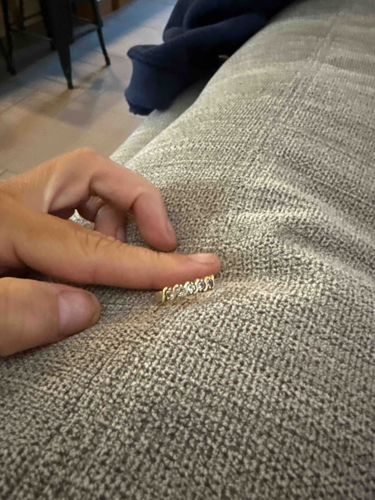
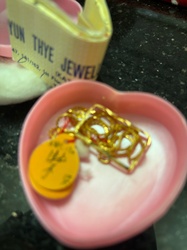
The item depicted is a gold eternity band featuring a series of what appear to be diamonds. The ring's band is a shiny, warm yellow-gold tone, suggesting it is likely crafted from yellow gold. The visible portion of the band shows five round, brilliant-cut stones, each set in an individual four-prong setting, creating a continuous line of sparkle. The separation between the settings suggests a classic common-prong or shared-prong design, allowing maximum light to enter the stones. Based on the visible sparkle and clarity, these stones are likely diamonds or high-quality diamond simulants. The overall construction appears delicate yet sturdy, indicative of fine jewelry. There are no obvious visible condition issues such as major scratches, dents, or missing stones from the angle provided. The metal appears polished and shows good luster. The craftsmanship seems precise, with the stones uniformly spaced and securely held. No specific maker's marks or signatures are discernible from the image, nor is a precise size or carat weight. The style is classic and timeless, often associated with wedding bands, anniversary bands, or stacking rings. While an exact age cannot be determined, this style has been popular for several decades, making it a potentially vintage piece or a more contemporary creation. The quality indicators point to a well-made piece of jewelry, with attention paid to the setting of the stones.
AI Appraisal Report
Upon visual examination of the provided image, I assess this gold and diamond eternity band (partial). The ring appears to be crafted from yellow gold, indicated by its warm tone and luster. The five visible stones are round brilliant cuts, held in four-prong settings, suggesting either a common-prong or shared-prong design, which optimizes light entry. The stones exhibit good sparkle and clarity, consistent with diamonds or high-quality diamond simulants. The overall condition appears excellent; I observe no significant damage, missing stones, or excessive wear. The craftsmanship seems fine, with uniformly spaced and securely set stones.
Market conditions for classic eternity bands remain strong, especially for well-made pieces. Comparables typically include similar styles ranging from mass-produced to high-end designer pieces. Demand for such versatile jewelry, suitable for weddings, anniversaries, or stacking, is consistently high, and these pieces are not inherently rare in style, though specific quality or stone size can influence rarity.
Factors significantly impacting value include the metal purity (e.g., 14k, 18k gold), the actual stone identity (diamond vs. stimulant), and the total carat weight of the stones. Without definitive verification, my valuation remains a range.
It is crucial to note the limitations of authenticity verification from images alone. I cannot definitively confirm if the stones are natural diamonds or simulants, nor can I ascertain the gold karatage. A full authentication would require in-person examination to test the metal purity (e.g., acid test, XRF), verify the stones with a diamond tester and loupe for inclusions, and potentially weigh and measure the stones for accurate carat weight estimation. Provenance documentation, if available, would also aid in establishing the item's history and potential origin.