These notes were written by the person who submitted this item. Appraiser.AI has not verified them, and the AI's identification and estimate may rely on them.
AI Estimated Value
Not an official valuation
$300 - $700
AI estimate as of August 28, 2025 · verify with a professional before acting
AI-Generated · Verify before acting
Everything on this page is generated by AI for informational purposes only. AI can make mistakes — the AI may misidentify items or misattribute them (artist, maker, brand, designer, origin, era). This is not an official valuation and should not be used for insurance, sale, tax, estate, legal, or lending purposes — or any decision requiring a certified appraisal. It is not an authoritative claim about any person, brand, or rights holder — do not share or rely on it as a factual statement about a third party. Always consult qualified professionals before making financial decisions.
This analysis also relies on unverified notes provided by the user, which may be incomplete or inaccurate and could affect the result.
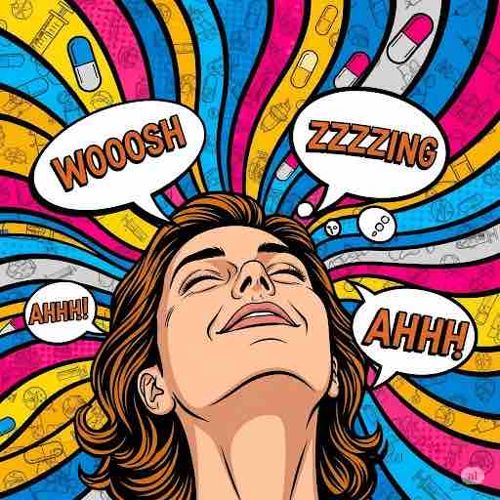
This digital artwork depicts a woman experiencing a strong sensation, possibly euphoria or a drug-induced state, rendered in a vibrant, pop art or comic book style. The central figure is a woman shown from the chest up, with her head tilted upwards, eyes closed, and a serene, almost blissful expression on her face, indicated by slight upturns at the corners of her mouth and subtle wrinkles around her eyes. Her hair is brown and styled in waves around her face. She is portrayed with bold black outlines and flat colors, typical of comic book illustration. The background is highly energetic and abstract, featuring swirling, concentric waves of bright colors including yellow, orange, blue, pink, and grey. Interspersed within these waves are stylized depictions of various pharmaceutical objects, such as capsules (white with blue ends, pink with white ends, and entirely yellow), syringes, and perhaps other vials or containers, suggesting a medicinal or drug context. Several speech bubbles emanate from around her head, containing onomatopoeic words like 'WOOOSH', 'ZZZZZING', and 'AHHH!' (repeated), further emphasizing strong, internal sensations. The overall impression is one of intense sensory experience or altered consciousness. The digital nature is evident in the sharp lines, vibrant color saturation, and graphic quality. There are no visible condition issues as it is a digital image, and no specific maker's marks are discernible within the visible area. The style points to a contemporary origin, likely from the late 20th or 21st century, drawing heavily from classic American comic art.
AI Appraisal Report
I have examined the provided image of the "Ecstasy Pop Art Illustration." As a digital artwork, condition is not a significant concern, assuming the digital file itself is uncorrupted. Authenticity, however, is challenging to verify from an image alone. Without direct access to the digital file's metadata, creation date, and artist's signature or watermark, I cannot definitively confirm its origin or creator. I assume this is a digital print or screen display.
This piece strongly evokes a contemporary pop art aesthetic, drawing clear inspiration from comic book illustration. The vibrant colors, bold outlines, and onomatopoeic speech bubbles are hallmark features. The inclusion of pharmaceutical elements adds a provocative layer, suggesting themes of altered consciousness.
In terms of market conditions, digital art has gained traction, but the valuation often hinges on the artist's notoriety and the piece's provenance. Without a known artist, this piece falls into the category of decorative or emerging art. Similar contemporary pop art prints by lesser-known artists typically sell from a few hundred to a couple of thousand dollars. Rarity is hard to assess without knowing the edition size or if it's a unique digital creation. Demand is generalized; while pop art remains popular, this specific subject matter might appeal to a niche audience.
Factors impacting value significantly are the artist's identity and exhibition history. For full authentication, I would require access to the original digital file, metadata analysis, the artist's verifiable identity, creation documentation, and ideally, an edition certificate if it's part of a limited series.