AI Appraisal Estimate

AI-generated estimates · not official valuations

From the user

What was submitted

Photo and notes provided by the user — not generated by AI

Submitted item photo
Submitted photo · May 27, 2026

User's notes

No additional notes provided.

AI analysis below

AI appraisal

AI analysis & estimate

AI-Generated · Verify before acting

Everything below is generated by AI for informational purposes only. AI can make mistakes — the AI may misidentify items or misattribute them (artist, maker, brand, designer, origin, era). This is not an official valuation and should not be used for insurance, sale, tax, estate, legal, or lending purposes — or any decision requiring a certified appraisal. It is not an authoritative claim about any person, brand, or rights holder — do not share or rely on it as a factual statement about a third party. Always consult qualified professionals before making financial decisions.

Read the full disclaimer

AI Identification

·Not independently authenticated·Verify before acting

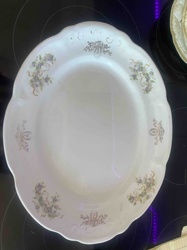
Vintage Oval Ceramic Floral Serving Platter

Antique Ceramics & Tableware

AI Estimated Value

·Not an official valuation·Verify before acting

$45 - $85

As of May 27, 2026

AI Item Analysis

·AI can make mistakes·Verify before acting
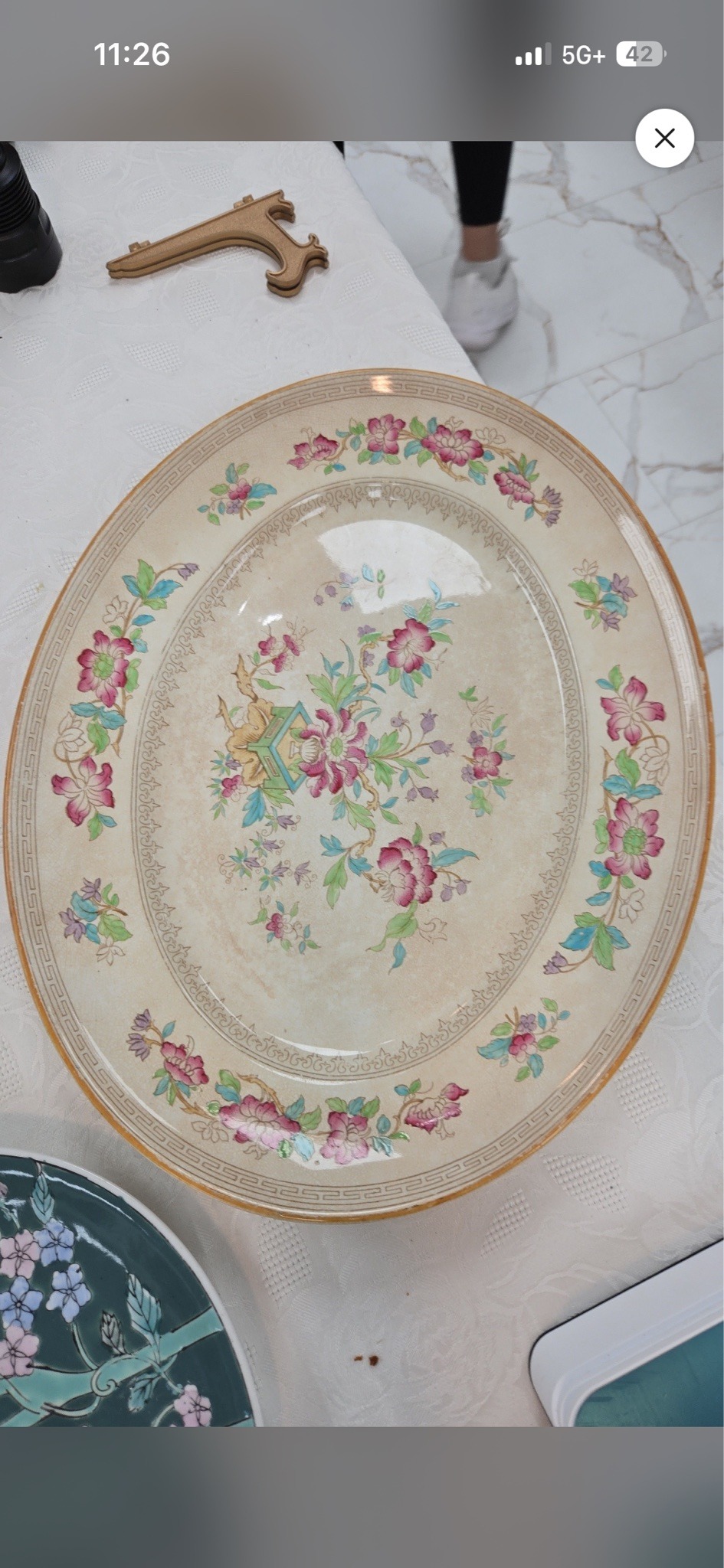
This is a large, oval-shaped ceramic serving platter featuring an Aesthetic Movement or Chinoiserie-inspired floral motif. The piece is constructed from earthenware or semi-vitreous porcelain with a cream-colored or light beige glaze base. The center well is decorated with a complex polychrome transfer-print design depicting a stylized garden scene, including a green architectural element (likely an urn or garden structure) surrounded by peonies, cherry blossoms, and delicate foliage in shades of magenta, teal, and lime green. Two concentric decorative borders frame the platter: an inner delicate lace-like scroll pattern and an outer Greek Key geometric band at the rim's edge. The outer flange is adorned with repeating floral sprays that echo the central design. Regarding condition, significant age-related crazing is visible across the entire surface, suggesting a soft-paste body common in late 19th to early 20th-century English or American pottery. There is notable brownish discoloration or 'tea staining' near the center, which occurs when organic matter penetrates the glaze through the crazing lines. Some edge wear and loss of gilding on the outermost rim are present. The craftsmanship suggests a mass-produced but high-quality decorative piece from the Victorian or Edwardian era, approximately 1890–1920.

AI Appraisal Report

·AI can make mistakes·Verify before acting
Based on my visual analysis of this Aesthetic Movement transferware platter, I have identified it as a specimen of late 19th-century mass-produced earthenware, likely of English or American origin (circa 1885–1910). The polychrome palette and Chinoiserie motifs of peonies and architectural urns are characteristic of the 'Japanesque' style popular during the Victorian era. While the transfer application is precise and the multi-bordered design (Greek Key and scrollwork) suggests higher-end commercial production of its time, the item's value is significantly impacted by its condition. I observe extensive overall crazing and prominent 'tea staining' or oxidation near the center well. Such discoloration occurs when fatty acids or moisture penetrate the porous earthenware body through the glaze; while common, it is generally undesirable to collectors compared to 'clean' examples. The market for Victorian transferware is currently saturated with similar floral patterns, and without a rare maker’s mark (such as Minton, Wedgwood, or Brown-Westhead Moore & Co.), these pieces are valued primarily for their decorative utility rather than as high-investment rarities. Limitations: This appraisal is based solely on digital imagery. A physical examination is required to detect professional restorations, hairline fractures hidden by crazing, or to verify the presence of impressed maker's marks on the reverse. Authenticity is assumed based on the specific degradation patterns of the glaze, but metallurgical or chemical testing of the pigment would be necessary to definitively rule out mid-20th-century reproductions. Provenance documentation regarding the original service set would further refine the valuation.

Get your items appraised

Instant estimates of your treasures with AI-powered appraisals

Browse More Appraisals