AI estimate as of June 27, 2025 · verify with a professional before acting
AI-Generated · Verify before acting
Everything on this page is generated by AI for informational purposes only. AI can make mistakes — the AI may misidentify items or misattribute them (artist, maker, brand, designer, origin, era). This is not an official valuation and should not be used for insurance, sale, tax, estate, legal, or lending purposes — or any decision requiring a certified appraisal. It is not an authoritative claim about any person, brand, or rights holder — do not share or rely on it as a factual statement about a third party. Always consult qualified professionals before making financial decisions.
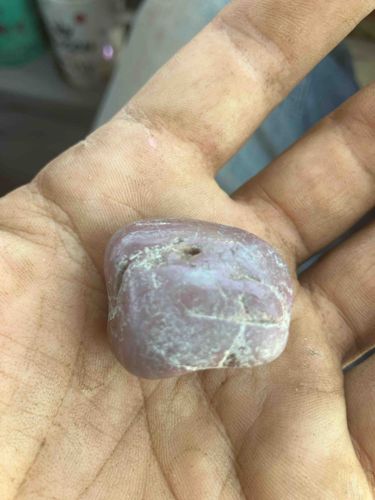
The item is a small, roughly tumbled or naturally water-worn stone, likely a mineral or gemstone, characterized by its predominantly pale purplish-pink to lilac color palette. Its physical characteristics suggest it is a single piece of stone, exhibiting an irregular, somewhat rounded shape with a relatively smooth surface, although areas appear mottled with white or lighter mineral veining and possibly surface residue. The stone is small enough to be comfortably held in the palm of a hand, as depicted in the image, suggesting its dimensions are on the order of a few centimeters. A notable feature is a small, central bore hole, indicating it was intended for stringing, perhaps as a bead or pendant component. The hole appears to be drilled through, not a natural opening. The surface shows some wear, minor pitting, and what appear to be natural fissures or cracks, which are darker in color. There are no discernible maker's marks, signatures, or specific manufacturing details beyond the drilled hole, which suggests a simple, functional modification for use. Given its appearance, it is difficult to precisely determine its age or specific geological origin without further testing, but it resembles stones often used in crafting or as good luck charms. The quality suggests a natural, untransformed stone, with craftsmanship limited to the drilling of the bead-hole. It appears to be in relatively good condition for its type, with no severe damage, though surface irregularities are present.
AI Appraisal Report
I have examined the provided image of the drilled, tumbled stone. Based on visual assessment, the item appears to be a natural mineral, possibly a form of quartz or chalcedony, given its typical purplish-pink to lilac coloration and translucent qualities. The condition is consistent with a naturally tumbled or artificially polished stone, showing inherent surface irregularities, minor pitting, and seemingly natural fissures. The drilled hole indicates it was modified for use as a bead or pendant component. I assess its authenticity as a natural stone to be high, though without direct physical examination, I cannot confirm the specific mineral type or rule out artificial coloring or treatment; however, its overall appearance suggests a natural origin. The craftsmanship is limited to the drilling of the bead-hole.
From my perspective, the market for such items, particularly as individual beads, is driven by hobbyists, crafters, and those interested in metaphysical properties of stones. Comparables would include similar tumbled stone beads available from mineral dealers, craft suppliers, or online marketplaces. Demand for individual, uncertified, common mineral beads is generally moderate, with rarity being very low for standard quartz/chalcedin varieties. Factors significantly impacting value are primarily its size, unique coloration (if truly natural and vibrant), and the identification of a potentially rarer mineral. However, without tactile examination and specific gravity/refractive index testing, I cannot definitively determine if it is a rarer material. Its most significant value is as a crafting component.
Limitations in authenticity verification from images alone are considerable. I cannot assess its specific gravity, hardness, refractive index, or internal characteristics (e.g., natural inclusions vs. artificial fillers), which are crucial for definitive mineral identification and detection of treatments. Therefore, I cannot confirm if it is rose quartz, amethyst, or another specific mineral, nor can I confirm if the color is natural or dyed. An in-person examination, coupled with spectrographic analysis or basic gemological testing (e.g., refractive index, specific gravity), would be necessary to confidently identify the stone and rule out treatments, thus establishing its true intrinsic value.