AI estimate as of July 12, 2025 · verify with a professional before acting
AI-Generated · Verify before acting
Everything on this page is generated by AI for informational purposes only. AI can make mistakes — the AI may misidentify items or misattribute them (artist, maker, brand, designer, origin, era). This is not an official valuation and should not be used for insurance, sale, tax, estate, legal, or lending purposes — or any decision requiring a certified appraisal. It is not an authoritative claim about any person, brand, or rights holder — do not share or rely on it as a factual statement about a third party. Always consult qualified professionals before making financial decisions.
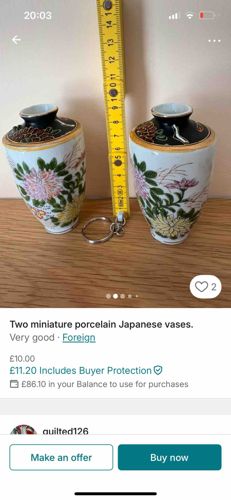
This is a pair of miniature porcelain Japanese vases, each approximately 10-12 cm in height, as suggested by the accompanying ruler. The predominant color of the body is white, serving as a canvas for intricate hand-painted floral designs, primarily featuring chrysanthemums in shades of pink, yellow, and green foliage, along with what appears to be decorative grasses or reeds. The neck of each vase is a contrasting black, adorned with finely detailed gold-colored patterns, possibly depicting abstract or stylized floral motifs, and a thin gold band separates the neck from the main body. Both vases have a flared rim, also accented with gold. The craftsmanship appears to be of good quality, with clear, vibrant colors and precise detailing, indicating a certain level of skill in their creation. There are no immediately visible cracks, chips, or significant wear, suggesting they are in 'very good' condition as stated in the listing. The reverse sides are not visible, so any further markings or design continuity cannot be assessed. Given the style of decoration, they likely date from the mid-20th century or later, consistent with common Japanese export wares. No specific maker's marks are visible in the provided image.
AI Appraisal Report
Based on my visual examination of the provided image, these miniature Japanese porcelain vases appear to be in 'very good' condition, showing no visible chips, cracks, or significant wear. The vibrant colors and precise hand-painted floral motifs, particularly the chrysanthemums, indicate good craftsmanship. The black neck with gold detailing and flared, gold-accented rim contribute to their decorative appeal.
Authenticity, based solely on imagery, is limited. While the style aligns with mid-20th century Japanese export wares, a definitive authenticity statement requires in-person examination. Physical inspection would allow me to check for porcelain quality, the application technique of the glazes and paint, and potential subtle repairs not visible in photos. Provenance documentation, such as original purchase receipts or family history, would significantly aid in verification. Furthermore, examining the base for any maker's marks, which are absent in this image, is crucial for full authentication and potential attribution to a specific workshop or artist, enhancing value.
In terms of market conditions, decorative porcelain vases of this type and period generally fall into the affordable collectibles category. Comparables found in online art and antique marketplaces suggest similar miniature Japanese export vases, without specific provenance or recognized makers, typically retail between $75 and $150 for a pair. Demand is moderate, driven by collectors of decorative arts and individuals seeking accent pieces for home decor. Rarity is low as such items were produced in relatively large quantities for export. Factors impacting value are primarily condition, decorative appeal, and the absence of a discernible maker. Were these identified as having significant artistic merit or historical importance, the value could be higher. Without physical inspection and further information, the lack of maker's marks and definitive dating limits the upper range of the appraisal.
My appraisal is limited to the visual information available; a complete, definitive appraisal would necessitate physical examination.