These notes were written by the person who submitted this item. Appraiser.AI has not verified them, and the AI's identification and estimate may rely on them.
AI Estimated Value
Not an official valuation
$600-1,200
AI estimate as of September 5, 2025 · verify with a professional before acting
AI-Generated · Verify before acting
Everything on this page is generated by AI for informational purposes only. AI can make mistakes — the AI may misidentify items or misattribute them (artist, maker, brand, designer, origin, era). This is not an official valuation and should not be used for insurance, sale, tax, estate, legal, or lending purposes — or any decision requiring a certified appraisal. It is not an authoritative claim about any person, brand, or rights holder — do not share or rely on it as a factual statement about a third party. Always consult qualified professionals before making financial decisions.
This analysis also relies on unverified notes provided by the user, which may be incomplete or inaccurate and could affect the result.
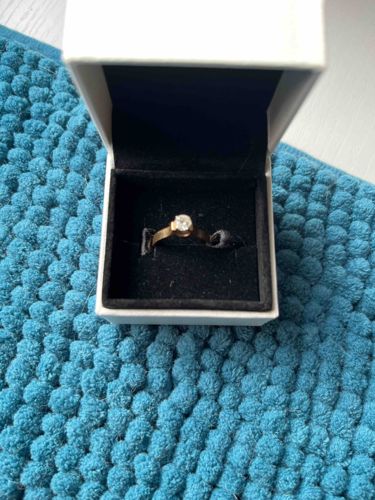
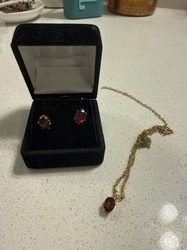
This item is a solitaire diamond ring, prominently featuring a single, round brilliant-cut diamond. The setting appears to be crafted from yellow gold, indicated by its warm, metallic hue. The band is smooth, with a fairly consistent width and a polished finish, suggesting a classic and understated design. The diamond is set in what appears to be a four or six-prong setting, securely holding the stone. The size of the diamond seems modest, likely between 0.25 and 0.75 carats based on visual estimation, though precise measurement is not possible from the image. The ring is presented within a small, rectangular jewelry box, typically used for rings, which is white on the exterior and lined with black velvet or a similar dark fabric on the interior to highlight the piece. The box itself shows no visible damage and appears clean. There are no discernible markings, maker's stamps, or detailed craftsmanship indicators visible in the provided image to ascertain the exact manufacturer or purity of the gold. The overall condition of the ring appears good, with no obvious signs of significant wear, scratches, or damage to either the metal or the diamond. The setting looks secure, and the metal retains its luster. Without additional information or clearer views, estimating a precise age is difficult, but the simple, classic solitaire design suggests it could range from a contemporary piece to one from the mid to late 20th century. The quality of craftsmanship appears standard for fine jewelry, with a focus on showcasing the central diamond.
AI Appraisal Report
Based on my visual examination of the provided image, this solitaire diamond ring in a yellow gold setting appears to be in good overall condition. There are no obvious signs of significant wear, scratches, or damage to either the metal or the diamond. The setting looks secure, and the metal retains its luster. The classic solitaire design suggests authenticity as a common jewelry piece. However, it's crucial to state that authenticity confirmation is limited to visual analysis of an image.
The market for classic solitaire diamond rings remains consistently strong, driven by their timeless appeal. For a diamond of 0.25 to 0.75 carats, as estimated visually, set in what appears to be 10k or 14k yellow gold, comparable new pieces generally range from $800 to $2,500, while pre-owned pieces often fall within the $500 to $1,500 range, depending heavily on the precise carat weight, color, clarity, and cut of the diamond. The demand for such pieces is steady. The rarity is low given the commonality of the design and materials.
Factors significantly impacting value include the precise diamond characteristics (4Cs: carat, color, clarity, cut) which cannot be determined from the image, and the purity of the gold. Without detailed information or clearer views, precise age estimation is difficult, though the design suggests mid-to-late 20th century to contemporary. To fully authenticate and accurately appraise this item, an in-person examination is essential. This would involve measuring the diamond's exact dimensions, assessing its color and clarity under magnification, identifying any specific inclusions, and testing the gold's purity. Provenance documentation, such as original purchase receipts or diamond certificates, would also significantly aid in a definitive appraisal.