AI estimate as of August 4, 2025 · verify with a professional before acting
AI-Generated · Verify before acting
Everything on this page is generated by AI for informational purposes only. AI can make mistakes — the AI may misidentify items or misattribute them (artist, maker, brand, designer, origin, era). This is not an official valuation and should not be used for insurance, sale, tax, estate, legal, or lending purposes — or any decision requiring a certified appraisal. It is not an authoritative claim about any person, brand, or rights holder — do not share or rely on it as a factual statement about a third party. Always consult qualified professionals before making financial decisions.
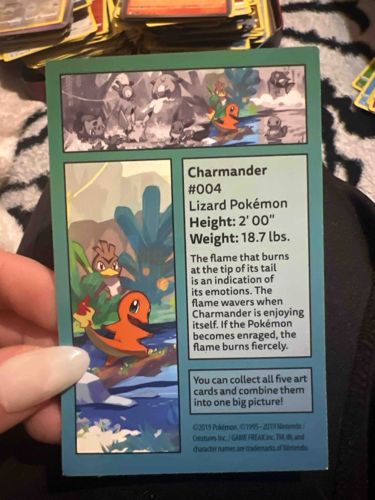
I have examined the provided image of the Charmander #004 Art Card (Pokémon), noting its distinct features, including the teal-green border, combined artwork potential with other cards, and copyright information indicating a 2015 origin. Based on the visual evidence, the card appears to be in relatively good condition, showing no major creases, tears, or significant surface abrasions. Minor edge wear or corner dulling, common with handled collectible cards, cannot be definitively ruled out without physical inspection, but overall presentation suggests a well-preserved state. The print quality and color saturation appear consistent with officially licensed Pokémon merchandise, suggesting authenticity.
From a market perspective, this is an art card rather than a traditional playable trading card, which generally places its value in a different segment. While part of a collectible set, art cards typically have lower demand and rarity compared to vintage, holographic, or rare variant trading cards. The 2015 copyright places it in a more modern production era, which tends to be less rare than older sets unless it's a very limited promotional item. Comparables for similar non-gameplay art cards from this era often range from a few dollars to perhaps twenty dollars, depending on the specific Pokémon and the completeness of the set. The fact that it's part of a five-card series whose appeal is enhanced when collected as a full set means individual cards often trade at a lower price point.
Important factors limiting the value include its nature as an art card versus a TCG card, its relative recency (2015), and the probable lack of extreme rarity. Demand exists primarily among casual collectors or those seeking to complete the specific art card set.
Limitations in authenticity verification from the image alone are significant. While the visible details align with authentic products, I cannot verify the card's texture, thickness, print fidelity under magnification, or holographic properties (if any, though none are indicated). For full authentication, a physical examination would be necessary to assess paper stock, ink types, and micro-printing. Provenance documentation, such as original packaging or purchase receipts, would also add to authentication certainty. Without these, my appraisal of authenticity remains based purely on visual cues from the provided image.