AI estimate as of August 12, 2026 · verify with a professional before acting
AI-Generated · Verify before acting
Everything on this page is generated by AI for informational purposes only. AI can make mistakes — the AI may misidentify items or misattribute them (artist, maker, brand, designer, origin, era). This is not an official valuation and should not be used for insurance, sale, tax, estate, legal, or lending purposes — or any decision requiring a certified appraisal. It is not an authoritative claim about any person, brand, or rights holder — do not share or rely on it as a factual statement about a third party. Always consult qualified professionals before making financial decisions.
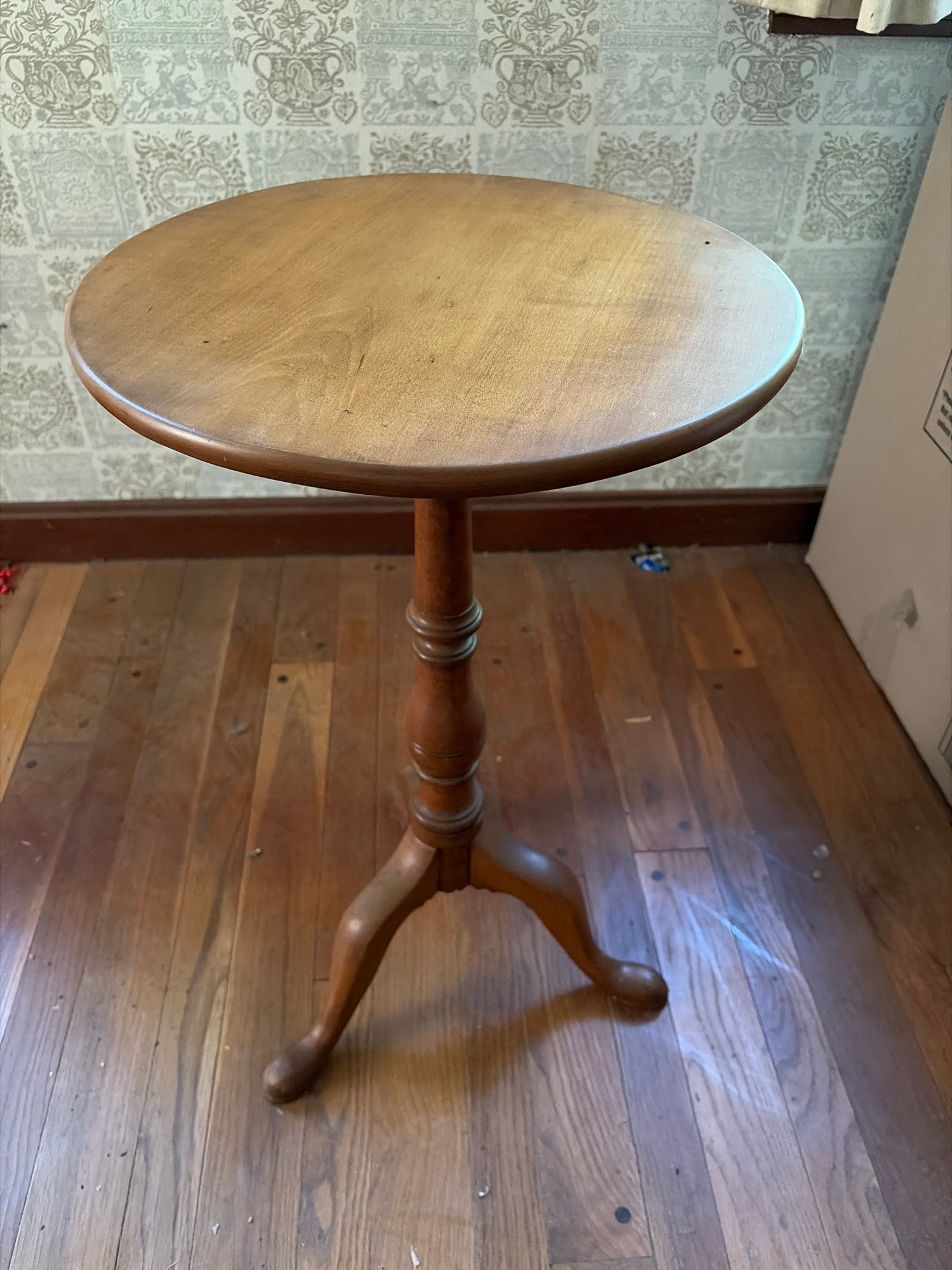
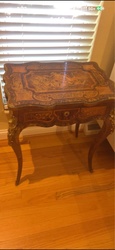
This is a freestanding occasional accent table featuring a circular wooden top supported by a central turned pedestal and three spreading cabriole legs. The table stands on wooden floors against a patterned wallpaper background. The tabletop is round with a smooth, slightly beveled edge, showing natural wood grain variations in medium brown tones. The central column exhibits traditional turning work with bulbous profiles and ring moldings, lending a classic architectural silhouette. The base consists of three curved, gracefully sweeping legs terminating in simple pad or round feet, consistent with a tripod spider-leg or birdcage-style pedestal table design commonly associated with 19th-century or revival craftsmanship. There are minor surface scuffs, light scratches, and tonal variations across the wooden surfaces typical of vintage furniture showing normal household use and age-related patina. No maker marks, stamps, or labels are visible in the image, so the identification relies entirely on the overall form, construction style, and silhouette characteristics. The craftsmanship suggests standard historical woodworking techniques, though a physical inspection of joinery and hardware would be necessary to fully evaluate its construction era and materials.
AI Appraisal Report
Based on what I can see in the photograph, this freestanding occasional accent table presents visual characteristics consistent with 19th-century Victorian tilt-top tripod furniture, featuring a circular wooden top, a turned central pedestal, and three cabriole legs. The medium brown wood grain, bulbous turning profiles, and sweeping pad-foot base suggest traditional craftsmanship of that era. However, I can't verify from a photo whether the joinery, hardware, and secondary woods align with true period construction, or if this represents a later revival piece, reproduction, or decorative copy made in the style of the period. No maker marks or labels are visible, and I would need physical inspection to confirm the wood species, age of the fasteners, and overall integrity. The estimated value range of $300-$500 assumes the hypothesis that the table dates to the 19th-century Victorian era. If physical inspection reveals the piece to be a later 20th-century reproduction, replica, or made simply in the style of the period, the market value would likely decrease significantly, typically falling into the $100-$200 range. General market demand for brown wooden accent tables of this scale has softened in recent years, though functional antique and vintage accent pieces with charming patinas still attract steady interest from decorators seeking traditional aesthetics. Minor surface scuffs, light scratches, and tonal variations noted across the wood indicate normal household use and age-related patina, which minimally impacts presentation but remains typical for vintage furniture. To establish a more precise evaluation and assess authenticity, an in-person examination by a qualified furniture conservator or antique specialist would be necessary to inspect the underside, block joints, and pivot mechanism.