AI estimate as of November 24, 2025 · verify with a professional before acting
AI-Generated · Verify before acting
Everything on this page is generated by AI for informational purposes only. AI can make mistakes — the AI may misidentify items or misattribute them (artist, maker, brand, designer, origin, era). This is not an official valuation and should not be used for insurance, sale, tax, estate, legal, or lending purposes — or any decision requiring a certified appraisal. It is not an authoritative claim about any person, brand, or rights holder — do not share or rely on it as a factual statement about a third party. Always consult qualified professionals before making financial decisions.
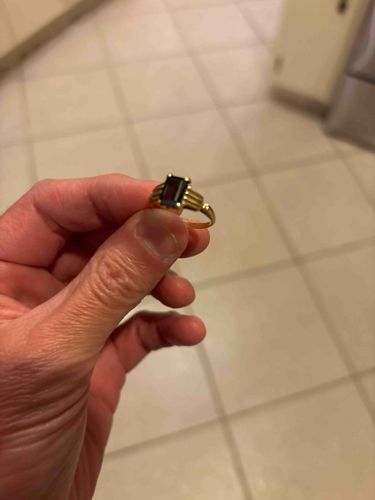
The item is a gold-toned ring featuring a prominent, centrally-set, emerald-cut gemstone. The gemstone exhibits a very dark hue, possibly a deep purple, black, or blue, which could suggest materials such as amethyst, black onyx, sapphire, or even a very dark garnet, though positive identification is not possible from the image alone. Its cut presents a rectangular facet pattern, typical of an emerald cut, maximizing light return and showing off the stone's depth. The stone is securely set within a bezel or prong-like setting that closely frames its perimeter. The ring's band is of a notable design, featuring multiple ribbed or fluted parallel lines that extend from the gemstone setting down the shoulders of the ring, creating a textured and somewhat architectural appearance before transitioning into a simpler, smooth band towards the back. The metal appears to be polished yellow gold or a similar gold-toned alloy, exhibiting a warm luster. There are no visible manufacturer's marks or signatures, but the overall design suggests a contemporary or mid-20th century aesthetic. The condition appears to be good with no obvious major damage, chips to the stone, or heavy scratching on the metal, judging from the limited resolution. The craftsmanship seems solid, with the gemstone well-seated and the fluting evenly executed, indicating a standard level of jewelry production.
AI Appraisal Report
Based on my visual examination of the provided image, this gold-toned ring features a prominent emerald-cut dark gemstone. The gemstone's hue is very deep, possibly amethyst, black onyx, or a dark sapphire, but a definitive identification is impossible without direct inspection and potential gemological testing. The setting appears secure, either bezel or prong-based. The condition of the ring seems good; I observe no obvious major damage, chips to the stone, or heavy scratching on the metal from the limited resolution. The craftsmanship, particularly the ribbed or fluted parallel lines on the shoulders, suggests a solid, commercial-grade production from potentially the mid-20th century to contemporary times. The metal appears to be polished yellow gold or a gold-toned alloy, but without hallmarks or direct testing, I cannot verify its purity. Market conditions for gold-toned jewelry with unidentified dark gemstones vary widely. Similar pieces with confirmed genuine gemstones (like natural sapphire or amethyst) and solid gold construction would command higher values. However, if the stone is synthetic or the metal is gold-filled/plated, the value would be significantly lower. Demand for this style is moderate, often driven by personal aesthetic preference rather than intrinsic rarity, as the design seems commercially produced. Factors significantly impacting value include the precise identification and quality of the gemstone (natural vs. synthetic, type, clarity), the purity of the metal (solid gold vs. plated/filled), and the presence of any maker's marks. For full authentication and a more precise valuation, an in-person examination is crucial. This would allow for proper gemological assessment of the stone, metal testing for purity and identification, and a thorough search for hallmarks. Without these, my appraisal is based on the assumption of a commercially viable, possibly mid-grade piece with an unverified dark stone.