AI estimate as of August 17, 2025 · verify with a professional before acting
AI-Generated · Verify before acting
Everything on this page is generated by AI for informational purposes only. AI can make mistakes — the AI may misidentify items or misattribute them (artist, maker, brand, designer, origin, era). This is not an official valuation and should not be used for insurance, sale, tax, estate, legal, or lending purposes — or any decision requiring a certified appraisal. It is not an authoritative claim about any person, brand, or rights holder — do not share or rely on it as a factual statement about a third party. Always consult qualified professionals before making financial decisions.
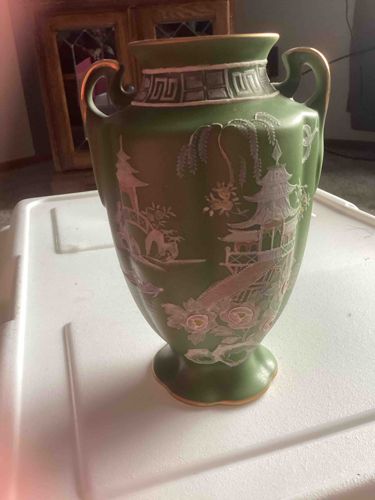
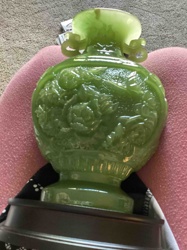
This is a ceramic vase, likely porcelain or earthenware, with a predominantly matte olive green or sage green glaze. The vase is of a medium size, appearing to be approximately 8-12 inches in height, with a classic urn or amphora shape featuring a prominent neck, a wider body, and a flared foot. It is adorned with two curved, ear-like handles, one on each side, extending from the upper portion of the body to just below the rim. The handles and the rim of the vase appear to have a gilded or gold-colored accent, showing some wear or patina. The decorative motif on the body of the vase is extensive and appears to be debossed or raised, featuring a 'chinoiserie' style landscape with pagodas, bridges, willow trees, and floral elements such as roses or peonies. These raised designs are rendered in a lighter, contrasting color, possibly white, cream, or a very light pink, which stands out against the green background. The neck of the vase also features a geometric band, possibly a Greek key or similar pattern, in a raised, lighter color. The overall condition appears good, with some visible dust or minor surface grime, and potential wear to the gilded accents, which is typical for an older piece. There are no obvious chips, cracks, or repairs visible from the provided images. The craftsmanship suggests it is a decorative piece, likely from the early to mid-20th century, possibly inspired by Asian art, and could be mass-produced or studio pottery.
AI Appraisal Report
Based on my visual examination of the image, this Chinoiserie style ceramic vase appears to be in good overall condition. There are no immediately obvious chips, cracks, or repairs, though some wear to the gilded accents and minor surface grime are visible, which is typical for an item of its presumed age. The predominant matte olive/sage green glaze with the contrasting raised 'chinoiserie' landscape motif, featuring pagodas, bridges, and floral elements, suggests a decorative piece from the early to mid-20th century. The 'chinoiserie' style was popular in Western decorative arts, drawing inspiration from East Asian aesthetics. The raised details and classic urn shape with ear-like handles are consistent with pieces produced during this period, likely either mass-produced for the decorative market or as studio pottery.
From the image alone, authenticity regarding maker or precise origin is limited. While the style is clear, verifying if it's a specific manufacturer, an antique reproduction, or a specific pottery artist would require in-person examination of hallmarks, impressed marks, and a thorough assessment of the ceramic body and glaze quality. Provenance documentation could also provide crucial historical context. Scientific testing of materials might confirm age if there's any doubt about it being a modern replica. Without a physical inspection, verifying the material (porcelain vs. earthenware) and manufacturing process details (e.g., hand-painted vs. transferware details) is difficult.
Market conditions for Chinoiserie style decorative ceramics are generally stable, with demand largely from collectors and interior decorators seeking classic aesthetic pieces. Items without specific maker's marks or significant provenance often fall into a broader decorative arts category. Comparables often include similar sized vases from the same period, particularly those with raised or applied decoration. Rarity is not particularly high for general decorative Chinoiserie pieces unless they can be attributed to a noted manufacturer or artist.
Factors significantly impacting value include definitive attribution to a known maker (e.g., Minton, Staffordshire, or specific Limoges ateliers), a higher quality of craftsmanship that can only be discerned in-person, or unique design elements. The current assessment is based on it being a well-preserved, attractive decorative piece without specific known attribution.