AI estimate as of August 23, 2025 · verify with a professional before acting
AI-Generated · Verify before acting
Everything on this page is generated by AI for informational purposes only. AI can make mistakes — the AI may misidentify items or misattribute them (artist, maker, brand, designer, origin, era). This is not an official valuation and should not be used for insurance, sale, tax, estate, legal, or lending purposes — or any decision requiring a certified appraisal. It is not an authoritative claim about any person, brand, or rights holder — do not share or rely on it as a factual statement about a third party. Always consult qualified professionals before making financial decisions.
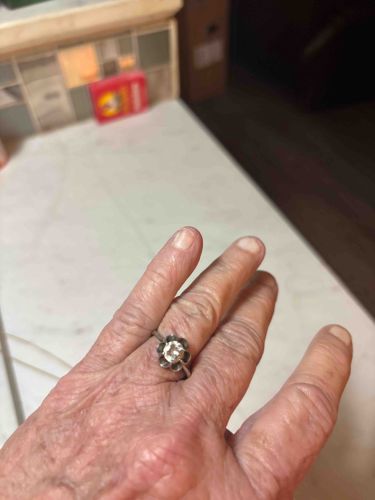
The item is a finger ring, likely made of a silver-toned metal, possibly sterling silver or white gold, given its color and apparent age. The ring features a central, clear, faceted gemstone, possibly a diamond, cubic zirconia, or white sapphire, set within a floral-inspired bezel or prong setting. The setting design mimics a blooming flower with approximately eight distinct petals surrounding the central stone. Each 'petal' appears to be individually sculpted or formed, creating a scalloped edge around the main gem. The band of the ring is relatively thin and appears to be a simple, unadorned hoop. Visible condition issues are minimal from the image; there might be some surface wear consistent with regular use, but no obvious damage such as bent metal or missing stones. The metal shows a soft luster, suggesting it has been cared for, or has developed a light patina over time. It appears to be a vintage piece, possibly from the mid-20th century (1940s-1960s) given its classic floral design, which was popular during that era. The craftsmanship appears competent, with a clear focus on presenting the central stone within an attractive and classic motif. No specific manufacturer marks or signatures are discernible from the provided image.
AI Appraisal Report
Upon visual examination of the provided image, I assess this Floral Solitaire Ring. The ring appears to be in good overall condition, showing minimal surface wear consistent with age and gentle use. The metal, likely a silver-toned alloy such as sterling silver, exhibits a pleasing luster. The central clear faceted gemstone, whose identity (diamond, cubic zirconia, or white sapphire) cannot be definitively determined from imagery alone, is securely set within an elegant eight-petal floral bezel. The craftsmanship, though not high-end luxury, appears competent and well-executed for its style.
Authenticity: Based solely on the image, I cannot conclusively authenticate the gemstone's material or the metal composition. To confirm the gemstone's authenticity and characteristics (e.g., cut, clarity, carat weight, color for diamonds), laboratory testing (e.g., refractometer, spectroscopy, diamond tester) would be essential. Similarly, metal analysis (e.g., XRF testing) would be required to verify its composition (e.g., sterling silver, white gold, platinum). No discernible hallmarks or maker's marks are visible, which limits precise dating or attribution.
Market Conditions & Demand: The classic floral solitaire design is perennially popular, especially among vintage jewelry enthusiasts. Similar styles from the mid-20th century, particularly if sterling silver or 10K/14K white gold with cubic zirconia or synthetic/natural white sapphires, typically command moderate prices. Demand is consistent for wearable vintage pieces in good condition.
Factors Impacting Value: The primary value determinant, assuming a non-diamond stone, is the metal content. If sterling silver, the value is modest. If white gold, it would be significantly higher. The age (estimated mid-20th century) adds some vintage appeal, but without provenance or maker's marks, it doesn't significantly elevate rarity. Its condition is a positive factor.
Limitations: My appraisal is solely based on visual interpretation of a single image. Definitive authentication of materials, especially the central stone and metal purity, as well as precise dating, requires physical examination, laboratory testing, and potentially provenance documentation. Without these, the true intrinsic value derived from precious materials cannot be fully ascertained.