AI Appraisal Estimate

AI-generated estimates · not official valuations

From the user

What was submitted

Photo and notes provided by the user — not generated by AI

Submitted item photo
Submitted photo · June 15, 2026

User's notes

No additional notes provided.

AI analysis below

AI appraisal

AI analysis & estimate

AI-Generated · Verify before acting

Everything below is generated by AI for informational purposes only. AI can make mistakes — the AI may misidentify items or misattribute them (artist, maker, brand, designer, origin, era). This is not an official valuation and should not be used for insurance, sale, tax, estate, legal, or lending purposes — or any decision requiring a certified appraisal. It is not an authoritative claim about any person, brand, or rights holder — do not share or rely on it as a factual statement about a third party. Always consult qualified professionals before making financial decisions.

Read the full disclaimer

AI Identification

·Not independently authenticated·Verify before acting

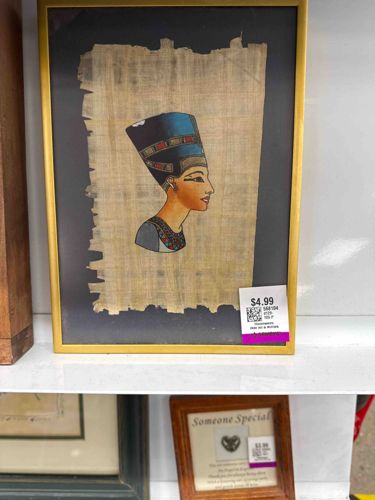
Framed Egyptian Papyrus Painting of Queen Nefertiti

Art / Collectibles

AI Estimated Value

·Not an official valuation·Verify before acting

$25.00 - $45.00

As of June 15, 2026

AI Item Analysis

·AI can make mistakes·Verify before acting
This item is a contemporary Egyptian papyrus painting featuring the iconic profile of Queen Nefertiti. The artwork is executed on a rectangular sheet of handmade papyrus, which exhibits its characteristic cross-hatched fibrous texture and natural tan coloration. The edges of the papyrus are intentionally deckled and irregular, a common stylistic choice in modern souvenir art to evoke antiquity. The portrait is rendered in a limited but vibrant palette, including deep turquoise blue for the tall flat-topped crown (khepresh), accented with red and gold bands. The queen's skin is depicted in a warm ochre tone with fine black lining for the eye and facial features. The bottom of the bust features a patterned collar in grey, red, and blue. The papyrus is float-mounted against a dark charcoal or black matte background, which provides high contrast for the light-toned fibers. It is housed in a simple, slim-profile gold-toned metallic or wood composite frame with glass glazing. Condition-wise, the papyrus appears stable with some slight natural warping as expected with the material. There are minor losses to the paint on the upper left portion of the blue crown. A modern retail price sticker ($4.99 from a thrift store) is adhered to the bottom right of the glass. The piece is a mid-to-late 20th-century tourist souvenir produced in Egypt, designed for the international export market.

AI Appraisal Report

·AI can make mistakes·Verify before acting
I have completed a visual inspection of the framed Nefertiti papyrus painting. This piece is a contemporary souvenir-grade artwork, likely produced in Egypt during the late 20th century for the tourist trade. The work is executed on authentic handmade papyrus, evidenced by the visible overlapping pith strips and deckled edges. While colorful and iconic, the painting technique is standard for mass-produced export wares, utilizing stenciled outlines with hand-painted infill. The condition is fair to good; however, I observed minor pigment loss on the blue khepresh crown and natural undulation of the papyrus substrate. The presence of a $4.99 thrift store sticker on the glass confirms its recent secondary market status as a decorative object rather than a fine art investment. Market demand for such pieces is high in volume but low in individual value, as they are ubiquitous in the resale market. Comparable items typically sell in the $20 to $50 range depending on the quality of the framing. This specific valuation reflects the decorative appeal of the gold-toned frame and the popularity of the Nefertiti motif. Final authentication of age and pigment composition is limited by the digital format of this examination. A physical inspection would be required to determine if the pigments are traditional mineral-based paints or modern synthetics. Furthermore, removing the backing would be necessary to check for any producer stamps or certificates of authenticity often included by Egyptian workshops, though such documentation would not significantly alter the valuation of a decorative tourist piece.

Get your items appraised

Instant estimates of your treasures with AI-powered appraisals

Browse More Appraisals