These notes were written by the person who submitted this item. Appraiser.AI has not verified them, and the AI's identification and estimate may rely on them.
AI Estimated Value
Not an official valuation
$150-350
AI estimate as of August 3, 2025 · verify with a professional before acting
AI-Generated · Verify before acting
Everything on this page is generated by AI for informational purposes only. AI can make mistakes — the AI may misidentify items or misattribute them (artist, maker, brand, designer, origin, era). This is not an official valuation and should not be used for insurance, sale, tax, estate, legal, or lending purposes — or any decision requiring a certified appraisal. It is not an authoritative claim about any person, brand, or rights holder — do not share or rely on it as a factual statement about a third party. Always consult qualified professionals before making financial decisions.
This analysis also relies on unverified notes provided by the user, which may be incomplete or inaccurate and could affect the result.
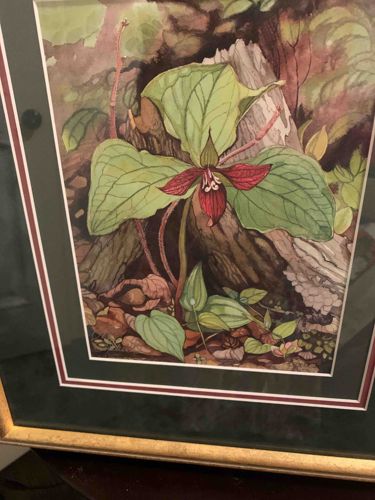
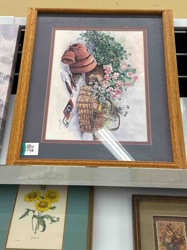
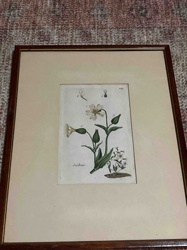
The item is a framed botanical artwork, likely a watercolor painting or a high-quality print of a watercolor, depicting a large, central Trillium flower (possibly Trillium erectum, also known as Red Trillium or Wake-robin) with deep red petals and prominent green leaves. The flower is shown amidst a naturalistic woodland setting, with a large tree trunk or fallen log serving as a prominent background element on the right, suggesting a forest floor. Smaller green plants and various shades of brown and earthy tones, possibly fallen leaves or soil, make up the foreground and surrounding environment. The color palette is rich and earthy, utilizing various shades of green for foliage, deep reds for the flower, and an array of browns and muted greens for the background. The brushstrokes, if a painting, appear detailed and naturalistic, capturing the textures of the plant life and wood. If a print, it is of sufficient quality to retain these details. The artwork is housed under glass within a multi-layered matting system. The innermost mat is a thin, dark red line, followed by a wider off-white or cream-colored mat, and then a broad, dark green outer mat. The entire piece is enclosed within a gold-toned wooden frame with a subtle decorative edge, exhibiting some visible wear or patina, consistent with age or normal handling. No significant damage to the artwork itself, such as tears, fading, or water damage, is immediately apparent from the image. The signature 'Mary Dawn Robert’s' is noted, indicating the artist or creator of this botanical piece. Without further information, the style period appears to be contemporary or late 20th to early 21st century, given its clean presentation and typical framing choices for such botanical subjects. The craftsmanship of both the artwork and its framing appears to be of good quality, suggesting it was produced by a skilled artist or printmaker and professionally framed.
AI Appraisal Report
Upon examination of the provided image, this framed botanical artwork, 'Red Trillium', signed by Mary Dawn Roberts, presents as a well-executed piece in very good condition. The work, likely a watercolor or a high-quality giclée print, showcases skilled rendering of the subject with a rich, earthy color palette. The multi-layered matting and gold-toned frame are professionally done and complement the artwork, though the frame exhibits minor wear consistent with its age. Without physical inspection, I cannot definitively determine if this is an original watercolor or a print; this distinction is the most significant factor impacting its value. An original watercolor would hold substantially more value than a print. The market for contemporary botanical art is steady, with prices for original works by established regional artists like Mary Dawn Roberts varying based on size and medium. Comparable original watercolors by artists with similar standing can sell for several hundred dollars, while signed, limited-edition prints typically trade in the low to mid-hundreds. To confirm authenticity and medium, an in-person examination under magnification is necessary to identify paper texture, paint application, or the dot matrix pattern of a print. Documentation of provenance or a certificate of authenticity would also be required for a definitive valuation.