AI estimate as of December 1, 2025 · verify with a professional before acting
AI-Generated · Verify before acting
Everything on this page is generated by AI for informational purposes only. AI can make mistakes — the AI may misidentify items or misattribute them (artist, maker, brand, designer, origin, era). This is not an official valuation and should not be used for insurance, sale, tax, estate, legal, or lending purposes — or any decision requiring a certified appraisal. It is not an authoritative claim about any person, brand, or rights holder — do not share or rely on it as a factual statement about a third party. Always consult qualified professionals before making financial decisions.
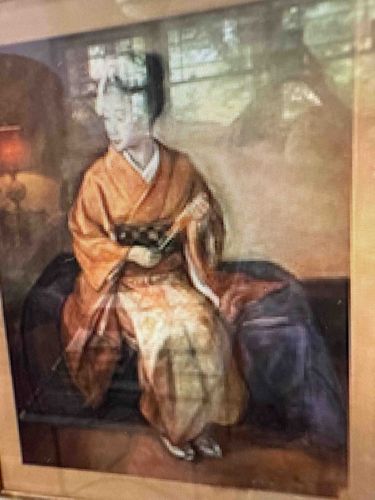
This item is a framed two-dimensional artwork, likely a print or painting, depicting a Japanese woman or geisha in traditional attire. The central figure is shown seated in profile, looking towards the left side of the frame. She wears a vibrant orange kimono, which features lighter, possibly golden or beige, fabric with a patterned design around the lower half and sleeves. A darker obi, appearing to be black or very dark brown, cinches her waist, adorned with what looks like floral motifs. Her hair is styled in a traditional elaborate coiffure, partially white or very light-colored, suggesting either a powdered wig or an artistic interpretation of hair color. Her skin tone appears fair. The background suggests an indoor setting, possibly a traditional Japanese room with sliding screens, and there's a soft, diffused light source, perhaps a window, visible behind her, creating some glare on the artwork's surface. On the left, a lamp with an orange hue lampshade is discernible, adding to the warm indoor atmosphere. The artwork exhibits a soft, somewhat muted color palette typical of certain Asian art styles or older prints. The overall condition appears to be good for its age, though the image quality makes it difficult to ascertain specific details of wear or damage directly on the artwork. However, some reflections and glare are visible on the protective covering (glass or acrylic) of the frame. The frame itself appears to be a simple, light-colored wooden or metallic frame, possibly gold-toned, showing minor scuffs or wear consistent with age and handling. This piece likely dates from the early to mid-20th century, given its aesthetic and common subject matter from that era.
AI Appraisal Report
I have examined the provided image of this framed two-dimensional artwork depicting a Japanese woman or geisha. Based on the visual evidence, it appears to be a print, rather than an original painting, likely mass-produced given the common subject matter and aesthetic. The soft, somewhat muted color palette and subject matter suggest an early to mid-20th century origin. The condition of the print itself appears good, though glare on the protective covering makes a definitive assessment challenging. The frame is simple, showing minor scuffs consistent with age, and appears to be a basic, possibly gold-toned, wood or metallic type.
In terms of market conditions, such decorative prints of Japanese figures were popular and widely produced. While appealing, they are not particularly rare at this price point unless they are exceptionally high-quality woodblock prints by a renowned artist, which this piece does not appear to be from the image. Demand exists for decorative Asian art, but the market is saturated with similar items, limiting individual value appreciation for common reproductions. Factors impacting value include the likelihood of it being a print rather than an original, the lack of artist signature, and general decorative quality rather than fine art status.
Authenticity of it being an original work of art cannot be verified from images alone. A physical inspection would be crucial to determine the medium (lithograph, woodblock print, giclee, or painting), the quality of the print, and to search for any hidden artist's seals or signatures. Provenance documentation could also shed light on its origin and potential value. Without such verification, this piece is appraised as a decorative print.