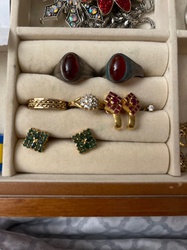
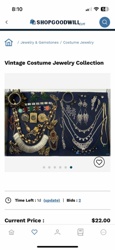
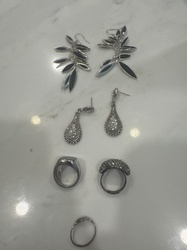
These notes were written by the person who submitted this item. Appraiser.AI has not verified them, and the AI's identification and estimate may rely on them.
AI Estimated Value
Not an official valuation
$3,500 - $4,500
AI estimate as of September 9, 2025 · verify with a professional before acting
AI-Generated · Verify before acting
Everything on this page is generated by AI for informational purposes only. AI can make mistakes — the AI may misidentify items or misattribute them (artist, maker, brand, designer, origin, era). This is not an official valuation and should not be used for insurance, sale, tax, estate, legal, or lending purposes — or any decision requiring a certified appraisal. It is not an authoritative claim about any person, brand, or rights holder — do not share or rely on it as a factual statement about a third party. Always consult qualified professionals before making financial decisions.
This analysis also relies on unverified notes provided by the user, which may be incomplete or inaccurate and could affect the result.
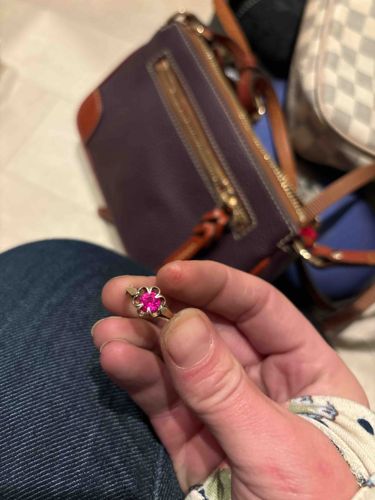
This item is an antique ring, likely crafted from 18-karat gold, as indicated by the context provided. The ring features a central cluster setting designed in the shape of a flower, with a prominent fuchsia-pink colored gemstone, identified as a ruby, at its center. This central ruby is surrounded by smaller, similarly colored stones, also rubies, arranged to form the petals of the flower. The overall color of the stones is a vibrant, saturated pinkish-red, characteristic of some ruby varieties. The gold setting appears to be a warm yellow gold, which complements the rubies. The band of the ring is slender and smooth. The craftsmanship suggests a handmade or at least a semi-handmade piece, typical of antique jewelry, with evident attention to detail in the setting of the stones. Given its 'antique' designation, the ring likely dates from the late 19th to early 20th century. There are no immediately obvious significant condition issues such as major scratches or missing stones; however, a closer inspection under magnification would be needed to assess minor wear, potential stone abrasions, or any subtle repairs. The metal shows a gentle patina consistent with age, and the prongs holding the stones appear intact. The size of the ring cannot be determined without a reference, but it appears to be of standard proportions for a women's ring. The style is classic and elegant, indicative of period fine jewelry.
AI Appraisal Report
Based on my visual examination of the provided image and the owner's description of this Antique 18K Gold Ruby Flower Cluster Ring, I assess its condition to be excellent for an antique piece. The craftsmanship appears consistent with fine jewelry of the late 19th to early 20th century, suggesting authenticity as an antique. The gold shows an appropriate patina, and the rubies, with their vibrant fuchsia-pink hue, are well-matched and exhibit good saturation. There are no immediately visible chips, cracks, or missing stones. The prongs holding the stones appear secure.
In terms of market conditions, antique jewelry, especially pieces featuring natural rubies and high-karat gold, maintains strong demand. The floral motif is classic and eternally popular, contributing to its broad appeal. Comparable sales for similar 18K gold ruby cluster rings of this period typically range from $3,000 to $5,000, depending on the exact size, quality of rubies, and specific karatage. While rubies of this quality aren't exceedingly rare, a well-preserved antique piece with harmonious design adds to its desirability and value. The 18K gold content is a significant value factor, ensuring a substantial precious metal weight.
My primary limitation in this appraisal is the absence of a physical examination. While the ring appears authentic, conclusive authentication of both the metal purity and the gemstones (natural vs. synthetic, origin treatment) would require in-person observation, scientific gemological testing (e.g., refractive index, specific gravity, spectroscopy), and potentially an XRF analysis for gold content. A detailed inspection under magnification would reveal minor wear, subtle repairs, or abrasions not visible in the image. Provenance documentation, if available, would further enhance certainty and value.