Photo and notes provided by the user — not generated by AI
Submitted photo · May 28, 2026
User's notes
No additional notes provided.
AI analysis below
AI appraisal
AI analysis & estimate
AI-Generated · Verify before acting
Everything below is generated by AI for informational purposes only. AI can make mistakes — the AI may misidentify items or misattribute them (artist, maker, brand, designer, origin, era). This is not an official valuation and should not be used for insurance, sale, tax, estate, legal, or lending purposes — or any decision requiring a certified appraisal. It is not an authoritative claim about any person, brand, or rights holder — do not share or rely on it as a factual statement about a third party. Always consult qualified professionals before making financial decisions.
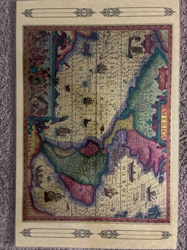
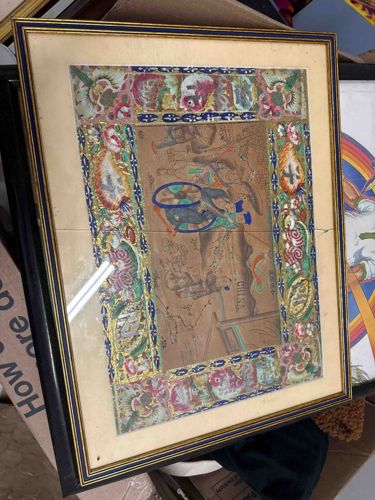
This item is a framed, ostensibly antique or vintage map of China, rendered with hand-coloring and surrounded by an intricately decorated border. The map itself appears to be printed on a sepia-toned or aged paper, showing geographical features and potentially some political divisions, though specific details within the map are difficult to discern due to its overall condition and resolution of the image. The text 'CHINA' is clearly visible in a vertical orientation on the right side of the map proper. The most striking feature is the elaborate, hand-painted border that surrounds the map. This border is rich in color, primarily featuring vibrant blues, greens, pinks, and yellows, with what appears to be gold or gilt accents used throughout. The motifs within the border are characteristic of traditional Chinese design, including floral patterns, stylized scrolls, and possibly mythical creatures or auspicious symbols, organized in repeating segments. The border has a somewhat three-dimensional quality, suggesting either detailed overpainting or perhaps even embroidered elements under the glass, though the latter is less likely. The item is protected under glass and housed within a multi-layered frame. The innermost layer is a thin gold-colored fillet, followed by a wider, off-white or cream-colored matboard, which frames the artwork directly. The outermost frame is a dark, possibly navy-blue, wooden frame with a subtle gold pinstripe along its inner and outer edges, suggesting a classic and elegant presentation. The visible condition includes general signs of age; the paper of the map seems to be discolored and possibly creased or folded, indicated by a vertical line running approximately through the center of the map. There are also visible dust or debris under the glass, particularly noticeable in the lower right corner of the mat. The frame itself shows minor wear consistent with handling and age. The craftsmanship of the hand-coloring on the border appears quite fine, indicating a degree of artistic skill. The combination of the map and the ornate border suggests a piece designed for decorative display as well as informational purposes, likely from the late 19th or early 20th century.
AI Appraisal Report
·AI can make mistakes·Verify before acting
I have examined the provided image of this framed, hand-colored Chinese map. The item presents as a decorative art object, likely dating from the late 19th to early 20th century. The intricate, hand-painted border, rich in traditional Chinese motifs and vibrant colors, is the primary draw, suggesting a high level of decorative craftsmanship. The map itself appears aged, with sepia toning and a visible vertical crease, indicating its vintage or antique status.
From the image, the condition appears consistent with age. There is general discoloration to the map paper and minor wear to the frame. The noticeable dust under the glass is a detractor that would ideally be addressed. The multi-layered framing is appropriate for the piece.
Market comparables for similar hand-colored antique maps with decorative borders, especially those with overt Chinese aesthetic, typically fall within this range. The artistic merit of the border enhances its decorative market appeal. Demand for such unique historical and artistic pieces remains steady among collectors of Asian art and cartography.
Authenticity of the map and hand-coloring appears consistent with the period; however, without an in-person examination, I cannot definitively confirm the age of the paper, the pigments used in the hand-coloring, or rule out later reproductions without physical inspection, UV light testing, or analysis of provenance documentation. Examination for printing techniques and microscopic analysis of paint layers would be essential for full authentication and to identify any restoration.