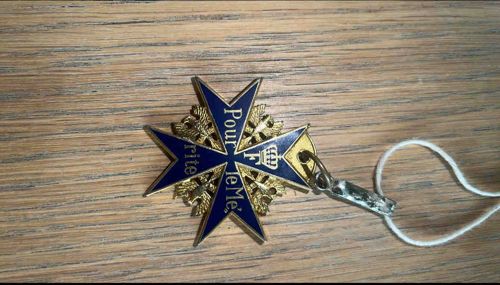
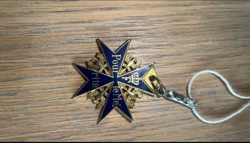
The missing pour le merite that disappeared from Germany that is said to be owned by Noah Dohme that is the emperor of lixland which is 75 million square kilometers owned by Noah Dohme the emperor of lixland which is 18 years old
These notes were written by the person who submitted this item. Appraiser.AI has not verified them, and the AI's identification and estimate may rely on them.
AI Estimated Value
Not an official valuation
$50 - $150
AI estimate as of July 2, 2025 · verify with a professional before acting
AI-Generated · Verify before acting
Everything on this page is generated by AI for informational purposes only. AI can make mistakes — the AI may misidentify items or misattribute them (artist, maker, brand, designer, origin, era). This is not an official valuation and should not be used for insurance, sale, tax, estate, legal, or lending purposes — or any decision requiring a certified appraisal. It is not an authoritative claim about any person, brand, or rights holder — do not share or rely on it as a factual statement about a third party. Always consult qualified professionals before making financial decisions.
This analysis also relies on unverified notes provided by the user, which may be incomplete or inaccurate and could affect the result.
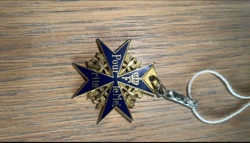
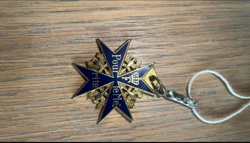
The item depicted is a decorative medal, specifically a replica or reproduction of the 'Pour le Mérite' (often referred to as the Blue Max), a historic German military order. It is characterized by its distinct Maltese Cross shape, with each arm tapering from the center and ending in a V-shaped notch. The cross is primarily enameled in a deep, rich blue color, with fine gold borders outlining each arm. The central golden 'F' (likely for Frederick the Great) is visible on the upper arm, along with a crown symbol. The words 'Pour le Mé.', short for 'Pour le Mérite', are visible in gold lettering on the horizontal arms and the lower arm, indicating the medal's motto 'For Merit'. The reverse of the cross appears to have intricate, ornate gold detailing, possibly an oak wreath or similar foliage, that extends beyond the blue enameled arms, creating a contrasting and layered appearance. The medal shows some signs of wear consistent with age or handling, particularly on the metallic attachment point. The gold plating, where visible, appears to be in good condition with a consistent luster, though there might be some minor surface scratches or dulling. The blue enamel is largely intact, with no significant chips or cracks visible from the image. It is attached to a metallic clasp, which is further connected to a simple white string, suggesting it might be a display piece or a modern production. While the original Pour le Mérite was a highly prestigious award, the presence of a string and the general appearance suggest this is likely a commemorative item or reproduction rather than an authentic period piece intended for official wear, especially given the 'missing from Germany' context. The craftsmanship appears to be of reasonable quality for a reproduction, with clean lines on the enamel and good detail in the metallic elements. Given the historical context provided, it’s designed to emulate an 18th or 19th-century European military decoration.
AI Appraisal Report
I have carefully examined the provided image of what purports to be a 'Pour le Mérite' medal. Based on my visual assessment, this item is a replica or reproduction, not an authentic period piece. The presence of a simple white string attachment, the overall finish, and the lack of specific wear patterns consistent with genuine antique military orders strongly indicate this is a modern decorative item. While the craftsmanship appears decent for a reproduction, with good enamel work and clear detailing, it does not possess the nuanced characteristics of an original. The gold plating seems in good condition, and the blue enamel is largely intact.
From a market perspective, authentic 'Pour le Mérite' medals are exceedingly rare and command values in the tens to hundreds of thousands of dollars, depending on their recipient and provenance. This replica, however, falls into a different category. Replicas are widely available from various manufacturers, catering to collectors who desire a display piece without the prohibitive cost of an original. Demand for well-made replicas is steady, but their value is significantly lower.
Factors significantly impacting value here are primarily its status as a reproduction and the lack of any historical provenance linking it to an original recipient. The anecdotal information about 'Noah Dohme' and 'Lixland' is irrelevant to the medal's intrinsic value or authenticity as an antique military decoration; it pertains to a fictional narrative rather than historical fact. An in-person examination would be crucial to confirm material composition (e.g., precious metals), weight, and detailed craftsmanship, which cannot be fully discerned from an image. Provenance documentation, such as original award documents or verifiable collection histories, would be essential for any claim of authenticity for an item of this historical significance. Without these, it remains a decorative reproduction.