AI estimate as of September 10, 2025 · verify with a professional before acting
AI-Generated · Verify before acting
Everything on this page is generated by AI for informational purposes only. AI can make mistakes — the AI may misidentify items or misattribute them (artist, maker, brand, designer, origin, era). This is not an official valuation and should not be used for insurance, sale, tax, estate, legal, or lending purposes — or any decision requiring a certified appraisal. It is not an authoritative claim about any person, brand, or rights holder — do not share or rely on it as a factual statement about a third party. Always consult qualified professionals before making financial decisions.
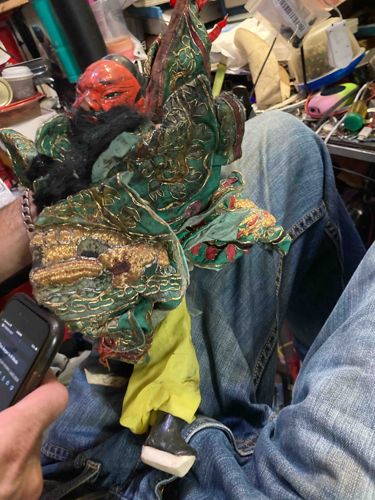
This is a traditional Chinese opera hand puppet, likely used in Bu Dai Xi (glove puppet theatre). The puppet features a vibrant, hand-painted wooden or papier-mâché head with a striking red face, prominent dark eyebrows and mustache, and a full black beard, suggesting a character of strong personality or military prowess, possibly Guan Yu or a similar figure due to the red coloring. The costume is elaborate, made of what appears to be silk or a similar finely woven fabric, predominantly green with rich gold threading forming intricate patterns, likely dragons, clouds, or auspicious motifs. There are also accents of deep red and possibly other colors within the embroidery. The craftsmanship of the embroidery suggests a high level of detail and traditional techniques. There is noticeable wear and tear on the fabric, including discoloration, fraying, and some loss of metallic threading, indicating significant age and use. The head shows minor chipping or loss of paint, consistent with handling over time. The puppet's internal structure is not visible, but the typical construction involves a hollow body for the puppeteer's hand, leading down to the characteristic 'feet' which are visible at the bottom of the image, appearing to be crafted from painted wood or resin in a blocky, stylized boot shape with white soles. The puppet's overall condition suggests it is an authentic, well-loved piece, likely late 19th to mid-20th century, retaining its original artistic integrity despite the signs of age.
AI Appraisal Report
Upon visual examination of the provided image, I assess this Traditional Chinese Opera Hand Puppet (Bu Dai Xi) as an authentic piece of folk art and performing arts memorabilia. The vibrant, hand-painted wooden or papier-mâché head, with its distinct red face and elaborate facial hair, is characteristic of traditional Chinese opera characters, possibly a figure like Guan Yu. The costume, crafted from what appears to be silk with intricate gold threaded embroidery depicting traditional motifs, further supports its authenticity. The noticeable wear, including discoloration, fraying, and loss of metallic threading on the fabric, along with minor paint chipping on the head, are consistent with significant age and practical use rather than intentional distressing. This wear is indicative of a well-loved and used piece, which often adds to its historical value.
Market conditions for authentic, older Chinese folk art and theatrical memorabilia such as Bu Dai Xi puppets are generally stable, with a niche but dedicated collector base. Comparables often include similar puppets from the late 19th to mid-20th century. Demand is moderate, driven by collectors interested in Asian cultural artifacts, puppetry history, and performing arts. The rarity of such well-preserved, used pieces naturally contributes to their value. Factors impacting this puppet's value positively include its apparent age, detailed craftsmanship, and the historical context of its use.
However, it is crucial to state that my authentication is based solely on visual cues from the image provided. Without a physical inspection, precise details regarding the materials (e.g., confirming silk fabric, wood or papier-mâché head), internal construction, and exact age cannot be definitively confirmed. For full authentication and a more precise valuation, an in-person examination would be necessary to assess material composition, inspect for repairs or alterations not visible in the image, and potentially identify specific regional styles or workshops. Documentation of provenance, if available, would also significantly enhance its verifiable authenticity and value.