AI estimate as of August 14, 2025 · verify with a professional before acting
AI-Generated · Verify before acting
Everything on this page is generated by AI for informational purposes only. AI can make mistakes — the AI may misidentify items or misattribute them (artist, maker, brand, designer, origin, era). This is not an official valuation and should not be used for insurance, sale, tax, estate, legal, or lending purposes — or any decision requiring a certified appraisal. It is not an authoritative claim about any person, brand, or rights holder — do not share or rely on it as a factual statement about a third party. Always consult qualified professionals before making financial decisions.
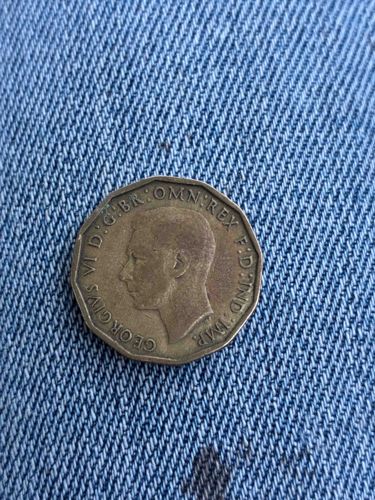
This item is a historical British coin, specifically a shilling featuring the effigy of King George VI. The coin is circular with a distinct twelve-sided (dodecagonal) shape, suggesting it is likely a 'new type' shilling issued during his reign. The material appears to be a copper-nickel alloy, common for British shillings of this period, exhibiting a brownish-grey patina consistent with age and typical circulation wear. The obverse side, which is visible in the image, displays the left-facing portrait of King George VI. Around the King's effigy, the inscription "GEORGIVS VI D: G: BR: OMN: REX F: D: IND: IMP" is clearly discernible, signifying 'George VI by the Grace of God, King of all Britons, Defender of the Faith, Emperor of India.' The lettering shows some softening due to wear, particularly on the higher points of the King's bust and the legend, but remains legible. There are no obvious signs of significant damage like deep scratches or gouges, but the overall surface shows typical signs of handling and light abrasion, contributing to the aged patina. The rim of the coin shows some minor irregularities, also consistent with circulation. The craftsmanship is typical of a minted coin, with clear, albeit worn, details in the engraving of the monarch's profile. The specific date is not visible on this side, but based on the monarch, it would be from 1937 to 1952. The overall appearance suggests a genuine, circulated coin from the mid-20th century.
AI Appraisal Report
Based on my visual examination of the provided image, I can confirm this is a genuine King George VI dodecagonal shilling. The distinctive twelve-sided shape and the effigy of King George VI, along with the clearly discernible inscription "GEORGIVS VI D: G: BR: OMN: REX F: D: IND: IMP," are consistent with known examples of this coinage issued between 1937 and 1952. The material, appearing as copper-nickel with a brownish-grey patina, is also correct for the type.
In terms of condition, the coin exhibits typical circulation wear, which I would classify as Fine (F) to Very Fine (VF) grade. The legend is legible, but there's softening on the higher points of the King's bust, indicating continuous handling. There are no apparent deep scratches, gouges, or significant damage, which is a positive factor. The rim shows minor irregularities, again, common for a circulated coin of this age. This level of wear is expected given its probable use in commerce.
Regarding market conditions, most King George VI dodecagonal shillings are relatively common as they were mass-produced. Their value is largely determined by their specific date (not visible here) and their condition. Circulated examples, like this one, command modest prices unless they are a key date. Rarity is generally low for common dates in this circulated condition. Demand is steady among collectors of British coinage, but it's not high enough to drive significant premiums for average examples.
Factors impacting its value include the commonality of most dates and its circulated condition. If this coin were a key date (such as 1946 with the 's' mintmark, or very high-grade uncirculated examples), its value would be considerably higher. Without seeing the reverse and the date, I must assume it's a common date.
It is crucial to note the limitations of authenticity verification from images alone. While I am confident in its authenticity based on typical visual markers, a full authentication would require in-person examination. This would allow for a precise weight and diameter measurement, edge examination for signs of tampering, and closer scrutiny of surface details under magnification to rule out any subtle counterfeiting techniques. Provenance documentation (if available) would further enhance its historical context and value, though it's less critical for common circulated coinage.