Signed Folk Art Landscape Painting
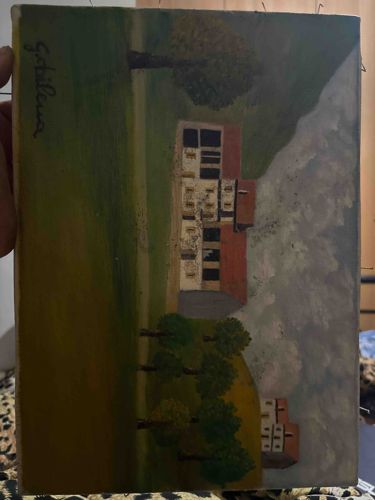
This is an original landscape painting executed in a Naive or Folk Art style, depicting a cluster of rural buildings situated in an open green field. The work is rendered on a rectangular support, likely canvas or board, and features a palette dominated by earthy greens, yellows, and muted greys. The composition includes a central two-story structure with a red roof, flanked by smaller architectural details and stylized trees. A signature which appears to read 'Galilua' or 'Gatilua' is prominently located in the upper left corner of the vertical orientation. The brushwork is flat and lack-depth, characteristic of amateur or mid-20th-century folk traditions. Condition-wise, the piece shows significant signs of age and neglect; there are visible abrasions, surface dirt, and notable paint loss/flaking in the center of the larger building. The edges show signs of fraying or wear where it may have been previously framed. Small pinholes are visible along the top edge, suggesting it was once tacked to a surface. The piece lacks a professional finish, which adds to its rustic, vernacular charm. Based on the materials and stylistic execution, it likely dates to the mid-to-late 20th century.
AI-Generated Appraisal Disclaimer
Estimated Value
$150 - $300
Basic Information
Category
Fine Art / Paintings
Appraised On
February 16, 2026
Estimated Value
$150 - $300
Item Description
This is an original landscape painting executed in a Naive or Folk Art style, depicting a cluster of rural buildings situated in an open green field. The work is rendered on a rectangular support, likely canvas or board, and features a palette dominated by earthy greens, yellows, and muted greys. The composition includes a central two-story structure with a red roof, flanked by smaller architectural details and stylized trees. A signature which appears to read 'Galilua' or 'Gatilua' is prominently located in the upper left corner of the vertical orientation. The brushwork is flat and lack-depth, characteristic of amateur or mid-20th-century folk traditions. Condition-wise, the piece shows significant signs of age and neglect; there are visible abrasions, surface dirt, and notable paint loss/flaking in the center of the larger building. The edges show signs of fraying or wear where it may have been previously framed. Small pinholes are visible along the top edge, suggesting it was once tacked to a surface. The piece lacks a professional finish, which adds to its rustic, vernacular charm. Based on the materials and stylistic execution, it likely dates to the mid-to-late 20th century.

Related Tags
Get Your Items Appraised
Instant estimates of your treasures with AI-powered instant appraisals