AI estimate as of October 23, 2025 · verify with a professional before acting
AI-Generated · Verify before acting
Everything on this page is generated by AI for informational purposes only. AI can make mistakes — the AI may misidentify items or misattribute them (artist, maker, brand, designer, origin, era). This is not an official valuation and should not be used for insurance, sale, tax, estate, legal, or lending purposes — or any decision requiring a certified appraisal. It is not an authoritative claim about any person, brand, or rights holder — do not share or rely on it as a factual statement about a third party. Always consult qualified professionals before making financial decisions.
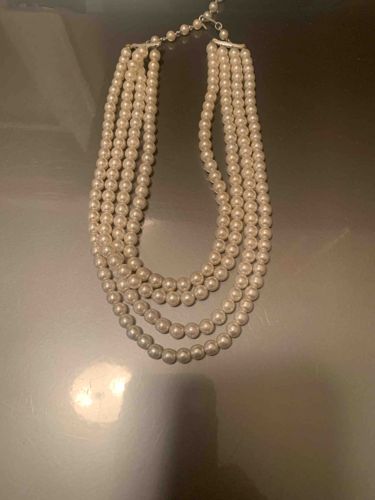
This item is a multi-strand faux pearl necklace, designed to create a cascading, voluminous effect around the wearer's neck. It consists of five individual strands of uniformly sized, spherical faux pearls. The pearls exhibit a creamy, off-white color with a moderate luster, suggesting they are likely imitation pearls, possibly made from glass or plastic with a nacreous coating. Each pearl appears to be approximately 6-8mm in diameter, strung together to form coherent lines. The total length of the necklace is not fully discernible, but it appears to be a choker or princess length, designed to sit snugly or just below the collarbone depending on the wearer. The necklace is secured by an adjustable closure mechanism at the back, featuring a hook clasp and an extender chain made of small, interconnected beads, all in a silver-toned metal. The metal connectors holding the strands together at each end are also silver-toned and have a somewhat rudimentary or simple design, suggesting a costume jewelry piece. There are no visible maker's marks or stamps in the provided images. The overall condition appears good, with no obvious signs of damage, missing pearls, or significant wear to the faux pearl coating. The craftsmanship seems consistent with mass-produced costume jewelry, likely from the mid to late 20th century, possibly 1950s-1980s, given the classic design. It presents a timeless elegance, often associated with vintage glamour.
AI Appraisal Report
I have virtually examined this multi-strand faux pearl necklace. The item appears to be in good condition, showing no obvious signs of damage, missing pearls, or significant wear to the faux pearl coating. The multi-strand design with five individual strands creates a classic, voluminous effect. The creamy, off-white, uniformly sized faux pearls, approximately 6-8mm, with moderate luster, strongly indicate they are imitation, likely glass or plastic with a nacreous finish. The silver-toned hook clasp, extender chain, and rudimentary metal connectors further suggest this is a piece of costume jewelry. There are no visible maker's marks or stamps, which is common for mass-produced costume pieces.
Authenticity, in this case, refers to its nature as costume jewelry, which appears consistent with the visual evidence. The classic design is reminiscent of mid to late 20th-century costume jewelry, potentially from the 1950s-1980s.
In terms of market conditions, vintage costume jewelry, especially pieces with faux pearls, generally commands modest prices unless associated with a significant designer or brand, which is not indicated here. Comparables often include similar unsigned multi-strand faux pearl necklaces found at estate sales or online marketplaces. Demand for such pieces is steady but not high, primarily appealing to collectors of vintage costume jewelry or individuals seeking an affordable classic accessory. Rarity is low; variations of this style were mass-produced. The lack of precious materials like genuine pearls or sterling silver significantly impacts value, placing it squarely in the costume jewelry category.
Limitations in authenticity verification from images alone include the inability to physically inspect the weight, texture, and density of the 'pearls,' which could help confirm their material (e.g., comparing plastic to glass). An in-person examination would allow for tactile assessment and closer inspection of construction. Scientific testing, such as specific gravity tests for the 'pearls,' or metallurgical analysis of the clasp, would be needed for absolute certainty regarding material composition. Access to provenance documentation would also be beneficial to confirm its age and origin.