AI Appraisal Estimate

AI-generated estimates · not official valuations

From the user

What was submitted

Photo and notes provided by the user — not generated by AI

Submitted item photo
Submitted photo · May 26, 2026

User's notes

cuadro barco japon o chino

AI analysis below

AI appraisal

AI analysis & estimate

AI-Generated · Verify before acting

Everything below is generated by AI for informational purposes only. AI can make mistakes — the AI may misidentify items or misattribute them (artist, maker, brand, designer, origin, era). This is not an official valuation and should not be used for insurance, sale, tax, estate, legal, or lending purposes — or any decision requiring a certified appraisal. It is not an authoritative claim about any person, brand, or rights holder — do not share or rely on it as a factual statement about a third party. Always consult qualified professionals before making financial decisions.

Note

This analysis also relies on unverified notes provided by the user, which may be incomplete or inaccurate and could affect the result.

Read the full disclaimer

AI Identification

·Not independently authenticated·Verify before acting

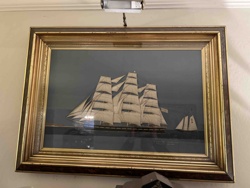
Chinese Woodblock Print of a Treasure Junk

Asian Art & Collectibles / Maritime Art

AI Estimated Value

·Not an official valuation·Verify before acting

$150-$250

As of May 26, 2026

AI Item Analysis

·AI can make mistakes·Verify before acting
This item is a framed Chinese woodblock print or lithograph depicting a traditional nautical scene, specifically a multi-masted Chinese Treasure Junk (Baochuan) sailing upon stylized waves. The composition is characterized by its use of 'batten sails' in a muted green and orange palette, a prominent hull detailed with architectural windows and patterns, and a large, serpentine dragon windvane or banner flowing from the main mast. To the upper right, there are multiple columns of Chinese calligraphy, which typically denote historical context or poetic descriptions of the voyage. The artwork is executed on what appears to be aged paper with a visible yellowish-tan patina, indicating some degree of age or intentional antiquing. The style mimics the traditional ukiyo-e or Chinese printmaking traditions with strong outlines and flat color zones. It is housed in a simple, narrow dark wood frame under glass. Condition-wise, the paper shows slight undulations and some signs of foxing or localized staining, particularly near the top margins. The craftsmanship reflects a decorative or souvenir-quality reproduction of a historical nautical chart or commemorative print, likely dating from the mid-to-late 20th century. The intricate line work in the rigging and the stylized treatment of the water are key quality indicators for this type of maritime folk art.

AI Appraisal Report

·AI can make mistakes·Verify before acting
After examining the digital documentation of this framed Chinese woodblock-style print, I have assessed it as a mid-20th-century decorative reproduction rather than an antique original. The piece depicts a Ming Dynasty-style Treasure Junk (Baochuan), rendered with the graphic stylization common in late-Republic or early People's Republic of China era maritime commemorative prints. The 'foxing' and yellowish-tan patina appear consistent with natural aging of cellulose-based paper from this period, though the flat color zones and uniformity of line suggest a lithographic or woodblock process intended for the souvenir or export market. The item is in fair to good condition; the undulations and localized staining noted in the upper margins are typical of moisture exposure and non-archival framing, which slightly detracts from the total value. Current market demand for 20th-century Asian maritime folk art remains stable but modest. Comparables for similar framed nautical lithographs typically realize between $100 and $300 at secondary auctions or through antique dealers specializing in nautical decor. The primary value drivers here are the aesthetic appeal and the specific subject matter of the Treasure Junk, which is of interest to maritime history enthusiasts. Please note: This appraisal is based solely on digital imagery. A definitive determination of the printing technique (identifying woodgrain impressions vs. lithographic screens) and paper age (via UV light examination or fiber analysis) would require an in-person inspection. For full authentication, I would recommend examining the paper fiber under 40x magnification and investigating the frame's back for any provenance labels or distributor marks.

Get your items appraised

Instant estimates of your treasures with AI-powered appraisals

Browse More Appraisals