AI Appraisal Estimate

AI-generated estimates · not official valuations

From the user

What was submitted

Photo and notes provided by the user — not generated by AI

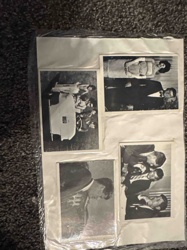
Submitted item photo
Submitted photo · May 18, 2026

User's notes

No additional notes provided.

AI analysis below

AI appraisal

AI analysis & estimate

AI-Generated · Verify before acting

Everything below is generated by AI for informational purposes only. AI can make mistakes — the AI may misidentify items or misattribute them (artist, maker, brand, designer, origin, era). This is not an official valuation and should not be used for insurance, sale, tax, estate, legal, or lending purposes — or any decision requiring a certified appraisal. It is not an authoritative claim about any person, brand, or rights holder — do not share or rely on it as a factual statement about a third party. Always consult qualified professionals before making financial decisions.

Read the full disclaimer

AI Identification

·Not independently authenticated·Verify before acting

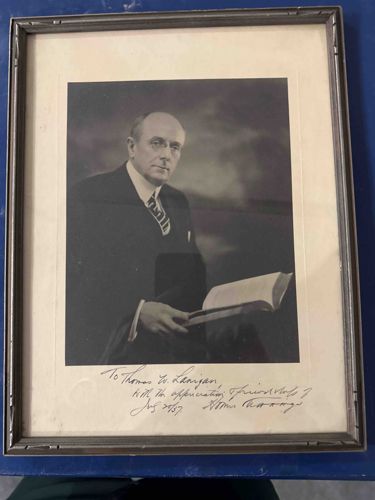
Signed Framed Portrait of a Distinguished Gentleman, Dated 1937

Historical Memorabilia / Photography

AI Estimated Value

·Not an official valuation·Verify before acting

$150 - $350

As of May 18, 2026

AI Item Analysis

·AI can make mistakes·Verify before acting
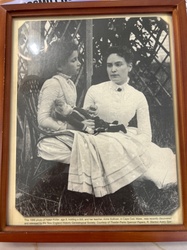
This item is a formal black-and-white studio portrait of an elderly Caucasian male, circa mid-20th century. The subject is depicted from the waist up, dressed in a dark three-piece suit, a crisp white collar, and a patterned necktie, holding an open book which suggests a scholarly, legal, or ministerial profession. The photograph is set against a mottled, dark studio backdrop that provides a soft depth to the image. Below the photographic plate, on the mounting board, there is a handwritten ink inscription that reads 'To Thomas W. Lanigan, With the appreciation of friendship / July 20/37' followed by a stylized signature that appears to be 'Arthur [Last Name]'. The piece is housed in its original or period-appropriate wooden frame featuring a decorative geometric or notched border with a metallic silver-toned or pewter finish. The overall construction consists of a glass cover, a light-cream colored mat board, and the photograph itself. Condition-wise, the matting shows visible age-related yellowing (toning) and minor foxing/staining, particularly in the lower-left corner. The frame displays minor abrasions and patina consistent with its age. The ink of the signature remains legible but may have slight fading. The craftsmanship reflects the professional portraiture standards of the 1930s, prioritizing formal composition and soft lighting.
AI Appraisal Report

·AI can make mistakes·Verify before acting
I have conducted a visual analysis of this 1937 studio portrait, dedicated to Thomas W. Lanigan. The piece is a quintessential example of mid-depression era formal photography. The composition, lighting, and use of a mounting board for the inscription are highly consistent with professional studio standards of the late 1930s. The condition shows expected signs of age; specifically, the mat board exhibits moderate toning and foxing, which suggests a non-archival environment, though the silver gelatin print (presumably) remains stable. The frame's pewter finish and geometric notch-work appear original, adding to the item's integrity as a period piece. The market for non-celebrity 20th-century portraiture is primarily driven by local history or the prestige of the sitter. While the inscription to 'Thomas W. Lanigan' (likely the Nebraska lawyer and politician) provides a regional provenance, the primary value driver is the signature of the subject, 'Arthur'. If the subject were identified as a figure of significant national importance, the value would appreciate substantially; currently, it is valued as high-quality historical memorabilia. Crucially, this appraisal is based on digital images alone and cannot confirm the chemical stability of the print or the authenticity of the ink. A physical inspection is required to verify if the signature is live ink or a printed facsimile. Full authentication would also necessitate provenance research to link the sitter and recipient, alongside a microscopic examination of the paper fibers and ink flow to rule out modern reproduction techniques.

Get your items appraised

Instant estimates of your treasures with AI-powered appraisals

Browse More Appraisals