AI estimate as of November 4, 2025 · verify with a professional before acting
AI-Generated · Verify before acting
Everything on this page is generated by AI for informational purposes only. AI can make mistakes — the AI may misidentify items or misattribute them (artist, maker, brand, designer, origin, era). This is not an official valuation and should not be used for insurance, sale, tax, estate, legal, or lending purposes — or any decision requiring a certified appraisal. It is not an authoritative claim about any person, brand, or rights holder — do not share or rely on it as a factual statement about a third party. Always consult qualified professionals before making financial decisions.
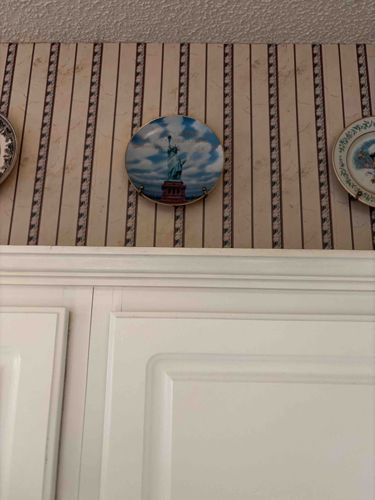
This item is a circular decorative plate featuring a central depiction of the Statue of Liberty against a backdrop of a blue sky with white, fluffy clouds. The Statue of Liberty is rendered in a greenish-blue hue, typical of its oxidized copper appearance, resting on a reddish-brown stylized pedestal. The overall color palette is dominated by blues, whites, and browns. The plate appears to be made of ceramic or porcelain, given its smooth, glossy surface and typical decorative plate construction. Its size cannot be precisely determined without a reference, but it seems to be a standard 'collector's plate' size, likely ranging from 6 to 10 inches in diameter. The plate is mounted on a wall using a gold-colored plate hanger, which clasps the rim at two points on the top and two points on the bottom, indicating it was designed for display. There are no visible chips, cracks, or significant wear evident from the image, suggesting it is in good, possibly excellent, condition. The borders of the plate are not strongly visible, but it appears to have a simple, possibly plain, rim without intricate patterns or gilding. This type of plate is often produced as a souvenir or commemorative item, suggesting a likely manufacturing period from the late 20th century to the early 21st century. The craftsmanship appears to be commercially produced rather than high-end artisan work, as is common for tourist-oriented memorabilia. No specific maker's marks or signatures are discernible from the provided image.
AI Appraisal Report
I have examined the image of the Statue of Liberty Souvenir Decorative Plate. Visually, the plate appears to be in good to excellent condition, with no observable chips, cracks, or significant wear. Its smooth, glossy surface suggests ceramic or porcelain construction. Its authenticity as a souvenir plate is evident from its design, though its origin beyond that is not determinable from the image.
Market conditions for souvenir decorative plates of this type are generally very low. While featuring an iconic landmark, such items are mass-produced with no inherent artistic or material value beyond their commemorative purpose. Comparable plates, often found at thrift stores, flea markets, or online secondary markets, typically fetch minimal prices. There is no indication of rarity; these plates are common tourist items. Demand is low, primarily appealing to niche collectors of Statue of Liberty memorabilia or decorative plates, but even then, the market is saturated with similar items.
The primary factors impacting its low value are its mass-produced nature, lack of artist attribution, and common design. Without any maker's marks, limited edition numbers, or unique craftsmanship, it falls into the category of general souvenir merchandise.
It is crucial to note that this appraisal is based solely on visual examination of the provided image. Limitations in authenticity verification from images alone include the inability to inspect the reverse side for maker's marks or backstamps, assess the material quality firsthand, or detect subtle surface imperfections not visible in photographs. An in-person examination would allow for tactile assessment of material, inspection for hidden flaws, and identification of any manufacturer's marks or dates, which could potentially, though unlikely, alter the appraisal. Provenance documentation or scientific testing are not typically relevant for items of this nature as they rarely hold significant historical or material value.