AI estimate as of September 17, 2025 · verify with a professional before acting
AI-Generated · Verify before acting
Everything on this page is generated by AI for informational purposes only. AI can make mistakes — the AI may misidentify items or misattribute them (artist, maker, brand, designer, origin, era). This is not an official valuation and should not be used for insurance, sale, tax, estate, legal, or lending purposes — or any decision requiring a certified appraisal. It is not an authoritative claim about any person, brand, or rights holder — do not share or rely on it as a factual statement about a third party. Always consult qualified professionals before making financial decisions.
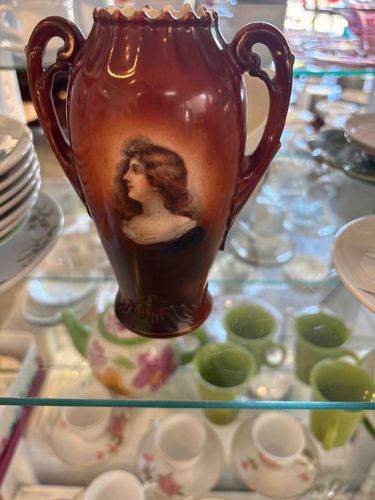
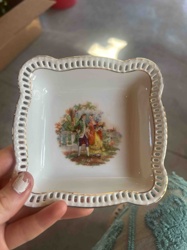
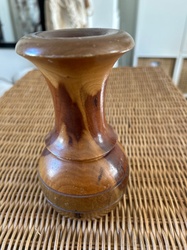
This item is a decorative porcelain vase, likely dating from the late Victorian to early Art Nouveau period, estimated late 19th to early 20th century. It stands modestly tall, featuring a rich, reddish-brown glaze that transitions into a lighter, almost peach-toned area on the front, serving as a background for a hand-painted portrait. The portrait depicts a young woman in profile, gazing left, with flowing, reddish-brown hair and a serene expression. Her attire suggests a classic or period style, with a dark bodice and a white ruffled collar or chemise detail. The overall construction of the vase is elegant, with two gracefully scrolled handles, one on each side, which are also finished in the same reddish-brown glaze, possibly with subtle gold accents highlighting their curves, though the resolution makes this difficult to confirm definitively. The rim of the vase is ruffled or scalloped, adding to its decorative appeal, and appears to have a delicate gold or cream trim. The base of the vase, though partially obscured, seems flared or footed, providing stability. There are no visible chips, cracks, or significant wear evident from the image, suggesting it has been well-preserved or carefully handled. The quality of the hand-painting on the portrait is indicative of craftsmanship common in this era, often found on 'cabinet vases' or decorative household items. The luster and depth of the glaze, combined with the detailed portraiture, suggest a higher quality ceramic piece, possibly from European production, though without a clear view of any marks, it's difficult to pinpoint the exact origin or manufacturer. The item serves purely as a decorative accent rather than a functional vessel.
AI Appraisal Report
Upon visual examination of the provided image, I have assessed this hand-painted porcelain vase. The piece presents as a beautiful example of decorative arts from the transitional period between the late Victorian era and the emergence of Art Nouveau, likely dating from circa 1890-1910. The form, with its scrolled handles and ruffled rim, along with the hand-painted portrait of a woman, is characteristic of 'cabinet vases' produced in Europe, possibly in Germany, Austria, or France, during this time. The quality of the portraiture is quite good, and the rich, flowing glaze appears to be in excellent condition with no visible chips, cracks, or crazing from the image provided. Based on these visual characteristics, I believe the vase to be authentic to the period described. The primary factor influencing its value is its decorative appeal and condition. Such portrait vases are relatively common on the market, but examples with high-quality artistry and in pristine condition command higher prices. Demand for this style is steady among collectors of Victorian and Art Nouveau decorative arts. Comparable vases of similar quality and unsigned origin typically sell in the $250 to $450 range at auction and in retail settings. The value is at the higher end of this range due to its well-preserved state and the artistic merit of the portrait. However, this appraisal is limited by the inability to perform a physical inspection. A full authentication would require examining the piece for any maker's marks on the base, which would be crucial in identifying the manufacturer and could significantly increase the value if it's a renowned porcelain house. Furthermore, physical inspection under UV light would confirm the absence of any hidden repairs or restorations.