These notes were written by the person who submitted this item. Appraiser.AI has not verified them, and the AI's identification and estimate may rely on them.
AI Estimated Value
Not an official valuation
$400 - $600
AI estimate as of July 24, 2025 · verify with a professional before acting
AI-Generated · Verify before acting
Everything on this page is generated by AI for informational purposes only. AI can make mistakes — the AI may misidentify items or misattribute them (artist, maker, brand, designer, origin, era). This is not an official valuation and should not be used for insurance, sale, tax, estate, legal, or lending purposes — or any decision requiring a certified appraisal. It is not an authoritative claim about any person, brand, or rights holder — do not share or rely on it as a factual statement about a third party. Always consult qualified professionals before making financial decisions.
This analysis also relies on unverified notes provided by the user, which may be incomplete or inaccurate and could affect the result.
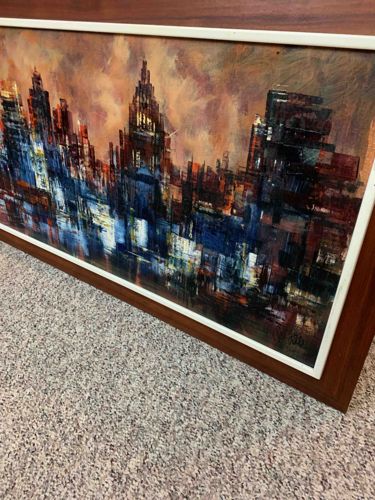
The item is a framed oil painting depicting an abstract cityscape, likely a nocturnal scene given the prominent use of artificial lights and their reflections. The painting exhibits a vibrant color palette dominated by deep blues, reds, oranges, and yellows, with a contrasting earthy or reddish-brown sky, suggesting either dusk, dawn, or an atmospheric effect. The brushwork is impressionistic and expressive, with thick impasto discernible in various areas, particularly in the illuminated windows and reflections, indicating a textured surface. The buildings are rendered as stylized blocks and vertical masses, some with distinct architectural forms, while others blend into the overall urban sprawl. The reflections in what appears to be water or a wet surface below the city are a significant feature, mirroring the verticality and color of the buildings above. The painting is housed in a contemporary-style wooden frame with a warm, reddish-brown finish. There is an off-white or cream-colored linen liner or mat separating the artwork from the frame, adding depth and a clean border. The overall condition appears good from the visible angle, showing no obvious signs of major damage like tears, punctures, or significant paint loss. The frame and mat also seem to be in good condition, without visible scratches or chips. The style suggests it could be from the mid-20th century, possibly the 1960s or 1970s, aligning with abstract expressionist or impressionistic cityscapes popular during that period. A signature is faintly visible in the lower right corner, though indecipherable from the provided image, which would be crucial for artist identification. The quality of composition and use of color suggest a professional artist, and the substantial frame indicates a considered presentation.
AI Appraisal Report
Upon examining this abstract cityscape oil painting, I am struck by its dynamic composition and expressive use of color and texture. The piece, rendered in oil, likely dates to the mid-20th century, circa 1960s-1970s, based on its stylistic alignment with post-war abstract and impressionistic trends. The artist demonstrates a skilled hand in their use of impasto to create depth and highlight the interplay of artificial light against a nocturnal or twilight urban environment. The overall condition, as observed from the image, appears to be very good, with no visible cracking, paint loss, or damage to the canvas. The substantial wooden frame with a linen liner is appropriate for the period and in good condition, suggesting the work has been well-cared for.
The market for mid-century abstract cityscapes by unlisted or regional artists is steady. While the piece is aesthetically pleasing and well-executed, its value is significantly impacted by the fact that the artist is currently unknown. The signature in the lower right corner is indecipherable from the photograph provided. Identifying the artist would be the single most important factor in determining a higher value. Comparable works by anonymous but skilled artists of this era typically sell in the decorative art market.
It is crucial to note the limitations of this appraisal, as it is based solely on a digital image. A definitive valuation and authentication would require in-person examination to assess the canvas texture, paint age, and the back of the painting for any gallery labels or inscriptions. Verifying the artist's signature and researching their sales history would be necessary for a full authentication.