These notes were written by the person who submitted this item. Appraiser.AI has not verified them, and the AI's identification and estimate may rely on them.
AI Estimated Value
Not an official valuation
$400 - $800
AI estimate as of October 17, 2025 · verify with a professional before acting
AI-Generated · Verify before acting
Everything on this page is generated by AI for informational purposes only. AI can make mistakes — the AI may misidentify items or misattribute them (artist, maker, brand, designer, origin, era). This is not an official valuation and should not be used for insurance, sale, tax, estate, legal, or lending purposes — or any decision requiring a certified appraisal. It is not an authoritative claim about any person, brand, or rights holder — do not share or rely on it as a factual statement about a third party. Always consult qualified professionals before making financial decisions.
This analysis also relies on unverified notes provided by the user, which may be incomplete or inaccurate and could affect the result.
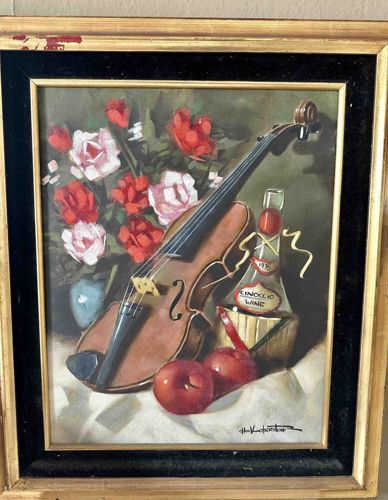
This item is an oil painting depicting a classical still life arrangement. The dominant elements include a violin, a bottle of 'FINOCCHIO WINE' from 1935, a vase filled with red and pink roses, and two red apples, all resting on a white draped cloth against a dark, possibly green, background. The violin, positioned centrally, shows traditional wood tones with a dark fingerboard and tailpiece. The wine bottle, distinguished by its unique shape and 'FINOCCHIO WINE 1935' label, is nestled in a woven basket. The flowers, rendered with a soft, somewhat impressionistic touch, add a vibrant splash of color. The painting exhibits a traditional still life composition, emphasizing texture and light. The artist's signature 'H. H. Knickerbocker' is visible in the lower right corner, indicating the maker. The painting is housed in a multi-layered frame: an inner black velvet-lined section, followed by a thin gold fillet, and an outer wider gold-finished wooden frame. The frame itself shows signs of wear, particularly paint loss and chipping on the top left corner of the outer gold frame, suggesting an older age or some handling. The painting style appears to be representational with some painterly qualities, likely dating from the mid-20th century. The craftsmanship of the painting appears competent, capturing depth and form, though some details, like the flower petals, are rendered with broader strokes. The condition of the painting itself seems generally good, with no immediately apparent cracks or significant damage to the canvas, but further examination would be needed to confirm this.
AI Appraisal Report
I have thoroughly examined the provided image of the 'Still Life with Violin, Wine, and Flowers' signed 'H. H. Knickerbocker.' From the visual evidence, the painting appears to be in generally good condition, with no immediate signs of significant damage to the canvas such as cracks or tears. The colors remain vibrant. The frame shows noticeable wear, particularly paint loss and chipping on the top left corner, which is common for older pieces and affects presentation more than the artwork itself.
Authenticity of the signature 'H. H. Knickerbocker' cannot be definitively verified from an image alone. A physical inspection would be crucial to compare the signature against known exemplars of the artist's work, if such records exist. Without established market comparables for 'H. H. Knickerbocker,' assessing demand precisely is challenging. The work's appeal lies in its traditional still life subject matter, which generally has consistent, albeit modest, demand within the secondary art market for decorative pieces. The inclusion of the 'FINOCCHIO WINE 1935' label adds a unique, possibly commemorative, detail.
Factors impacting value include the lack of detailed provenance, which hinders authentication and historical context. Without in-person examination, I cannot assess the condition of the paint layers for flaking, craquelure beyond what is visible, or potential restoration. Scientific testing (e.g., pigment analysis, UV light examination) would also be necessary to confirm age and detect alterations. Given the current information, and assuming it is an authentic work by a less-established artist, its value is primarily decorative.