These notes were written by the person who submitted this item. Appraiser.AI has not verified them, and the AI's identification and estimate may rely on them.
AI Estimated Value
Not an official valuation
$15-35
AI estimate as of July 21, 2025 · verify with a professional before acting
AI-Generated · Verify before acting
Everything on this page is generated by AI for informational purposes only. AI can make mistakes — the AI may misidentify items or misattribute them (artist, maker, brand, designer, origin, era). This is not an official valuation and should not be used for insurance, sale, tax, estate, legal, or lending purposes — or any decision requiring a certified appraisal. It is not an authoritative claim about any person, brand, or rights holder — do not share or rely on it as a factual statement about a third party. Always consult qualified professionals before making financial decisions.
This analysis also relies on unverified notes provided by the user, which may be incomplete or inaccurate and could affect the result.
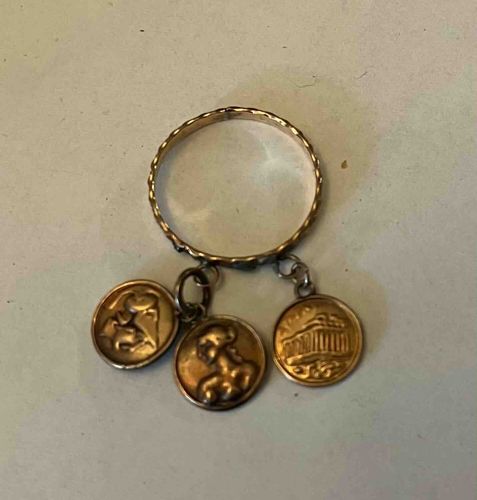
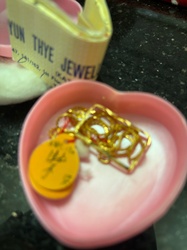
This item is a charm ring, featuring a simple, thin gold-toned band from which three distinct charms are suspended. The band itself appears to be made of metal, likely brass or a gold-plated base metal, and exhibits a slightly corrugated or textured surface on its outer edge, providing a subtle decorative element. The overall color is a warm, somewhat muted gold, suggesting either age-related patina or a specific alloy. The charms are circular and three-dimensional, each attached to the band by a small, simple jump ring. The leftmost charm depicts a stylized figural image, possibly a mythological creature or a human figure in profile, though specific details are a bit indistinct due to resolution and potential wear. The middle charm also features a figural design, possibly an angel or cherub, with discernible wings and a flowing form. The rightmost charm is clearly identifiable as a miniature rendition of the Lincoln Memorial, complete with columns and steps, indicating a possible connection to American historical themes. All three charms appear to be made from a similar gold-toned metal, with the figural charms showing signs of light surface wear, consistent with regular handling or age, as well as some darkening in recessed areas, which could be oxidation or accumulated grime. The Lincoln Memorial charm shows a crisper relief, suggesting perhaps lighter wear or better preservation. There are no visible maker's marks or signatures apparent in the image. Given the style of the charms and the overall construction, this piece likely dates from the mid to late 20th century, possibly as a souvenir or a collectible novelty item. The craftsmanship appears to be commercial grade rather than fine jewelry, focusing on popular imagery and a relatively simple assembly.
AI Appraisal Report
Upon my virtual examination of this charm ring, I observe a simple gold-toned band suspending three distinct charms: a stylized figural, another figural (possibly an angel/cherub), and a miniature Lincoln Memorial. The band appears to be a base metal, likely brass or gold-plated, exhibiting a slightly corrugated texture. The overall muted gold tone suggests either age-related patina or an intentional finish. The charms, similarly gold-toned, are attached via simple jump rings. Condition-wise, the figural charms show light surface wear and some darkening in recessed areas, consistent with age or handling. The Lincoln Memorial charm appears crisper, indicating potentially less wear. No maker's marks are visible, which is common for commercial-grade novelty items of this type.
Authenticity, based solely on the image, seems consistent with a mid to late 20th-century souvenir or collectible. The craftsmanship is not indicative of fine jewelry. Market conditions for such novelty or souvenir charm rings are generally modest. Comparable items, often found in antique or second-hand shops specializing in costume jewelry, typically retail from a few dollars to perhaps twenty-five. Demand is niche; while individual charm collectors might be interested, the general market is not strong. Rarity is low, as similar items were mass-produced. The primary factors impacting value are its material (base metal), lack of identifiable designer or historical significance, and common design elements.
Limitations in authenticity verification from images alone are significant. A physical examination would allow for definitive metal testing (e.g., specific gravity or XRF analysis) to confirm the metal composition of both the band and charms, assessing for actual gold plating thickness or solid gold content (though unlikely for this style). An in-person inspection would also permit a much clearer assessment of the extent of wear, patina, and any subtle identifying marks not visible in the photo. Provenance documentation, such as original sales receipts or family history, could potentially add collectible value if connected to a significant event or person, but none is provided. Without physical touch and detailed examination, attributing a high value would be unfounded.