AI estimate as of August 21, 2025 · verify with a professional before acting
AI-Generated · Verify before acting
Everything on this page is generated by AI for informational purposes only. AI can make mistakes — the AI may misidentify items or misattribute them (artist, maker, brand, designer, origin, era). This is not an official valuation and should not be used for insurance, sale, tax, estate, legal, or lending purposes — or any decision requiring a certified appraisal. It is not an authoritative claim about any person, brand, or rights holder — do not share or rely on it as a factual statement about a third party. Always consult qualified professionals before making financial decisions.
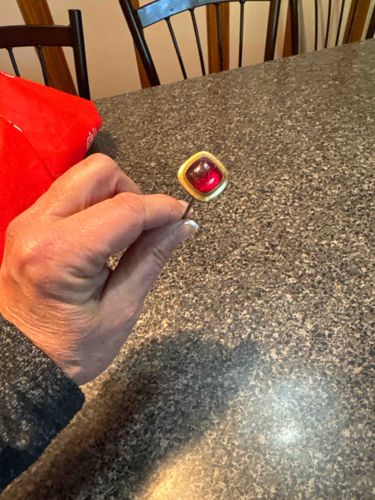
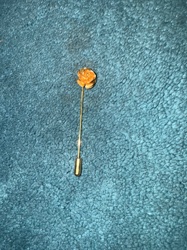
The item is a small, ornate stick pin, likely made of metal with a decorative head. The head features a prominent, square-shaped, cabochon-cut stone, which appears to be a deep red color, possibly a garnet or a glass imitation. This stone is set within a bezel or raised frame of a yellow-toned metal, possibly gold, gold-plated, or brass, which has a slightly aged or tarnished appearance, suggesting some patina. The metal setting around the stone has a curved, almost cushion-like profile, adding dimension to the design. The stick component itself is a slender, dark-colored shaft, typical of stick pins, designed to be inserted through fabric. The visible portion of the shaft (pin stem) also appears to be metal, contrasting with the possibly brighter head. The overall condition appears good, with no obvious signs of significant damage like chips or cracks on the stone, although the metal setting shows some degree of light wear or oxidation consistent with age. There are no visible maker's marks or stamps in the provided image. Based on its design and general aesthetic, this stick pin could date from the late 19th or early to mid-20th century, a period when such accessories were popular. Its craftsmanship suggests a piece of modest to good quality.
AI Appraisal Report
Upon visual examination of the provided image, I assess this vintage red stone stick pin. The condition appears to be good, with the square-shaped, cabochon-cut red stone seemingly intact without obvious chips or cracks. The yellow-toned metal setting shows age-consistent patination and light wear, but no severe damage. Authenticity, based solely on the image, is challenging to confirm for both the stone and metal. The red stone could be a natural garnet, which would significantly increase its value, or a glass imitation, synthetic, or another simulant. The metal's composition (gold, gold-plated, or brass) also cannot be definitively determined from a photograph; if solid gold, the value would be higher.
Market conditions for vintage stick pins are generally moderate. While collectible, demand fluctuates. Most comparables for similar non-precious examples with generic stones fetch modest prices. If the stone is proven to be natural garnet and the metal solid gold, demand would increase among specialized collectors. Rarity is difficult to ascertain, but without unique markers or provenance, it's likely a relatively common piece from the late 19th or early 20th century. Factors significantly impacting value include the true identity of the red stone and the metal, the presence of any hidden maker's marks, and verified provenance.
Limitations in authenticity verification are significant. A hands-on examination is crucial to determine the stone's type and origin using refractometry, spectroscopy, or specific gravity testing. Metal testing (e.g., acid test or XRF) is necessary to confirm its composition. Furthermore, magnified inspection might reveal hidden maker's marks. Without these in-person assessments, the appraisal remains largely speculative regarding intrinsic material value.