These notes were written by the person who submitted this item. Appraiser.AI has not verified them, and the AI's identification and estimate may rely on them.
AI Estimated Value
Not an official valuation
$500-800
AI estimate as of October 22, 2025 · verify with a professional before acting
AI-Generated · Verify before acting
Everything on this page is generated by AI for informational purposes only. AI can make mistakes — the AI may misidentify items or misattribute them (artist, maker, brand, designer, origin, era). This is not an official valuation and should not be used for insurance, sale, tax, estate, legal, or lending purposes — or any decision requiring a certified appraisal. It is not an authoritative claim about any person, brand, or rights holder — do not share or rely on it as a factual statement about a third party. Always consult qualified professionals before making financial decisions.
This analysis also relies on unverified notes provided by the user, which may be incomplete or inaccurate and could affect the result.
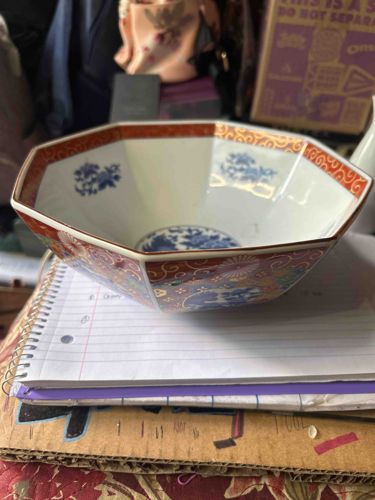
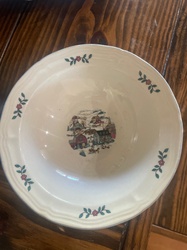
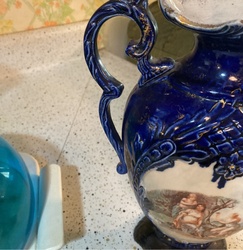
This is a large, octagonal serving bowl crafted from porcelain, exhibiting a traditional Imari-style decoration. The interior of the bowl features a clean white ground with alternating panels of vivid blue and white floral or landscape motifs. In the center, there appears to be a larger, more intricate blue and white design, possibly depicting a landscape or a stylized floral arrangement, although the exact details are obscured by the angle. The rim of the bowl is edged in a prominent red-orange band, bordered by a repeating pattern of golden scrolls or foliage. The exterior of the bowl showcases a rich and complex polychrome decoration. It appears to be divided into panels, each containing elaborate designs in a palette including red-orange, blue, gold, and possibly other colors that are less discernible. The intricate patterns suggest a high degree of craftsmanship. The bowl is hexagonal, giving it a distinctive geometric form that lends itself well to decorative display as well as practical use. While no specific maker's marks, signatures, or stamps are visible from the provided image, the style strongly indicates a Japanese origin, likely dating from the late 19th to early 20th century, common for Imari ware. The condition appears to be good with no obvious chips or cracks visible, though a more thorough inspection would be required to confirm the absence of wear, repairs, or minor imperfections consistent with age and use. The quality of the hand-painted details and the vibrant color palette are indicators of a well-executed piece of decorative ceramic art.
AI Appraisal Report
Based on my visual examination of the provided image, this large, octagonal Imari-style serving bowl presents as a finely decorated piece of Japanese porcelain. The vibrant polychrome decoration, featuring the characteristic red-orange, blue, and gold palette, aligns well with traditional Imari ware. The detailed floral and perhaps landscape motifs on both the interior and exterior panels indicate a skilled hand. The hexagonal form, though described as octagonal in the submission, adds to its distinctive aesthetic appeal. From the image, the condition appears good, with no obvious chips, cracks, or significant wear visible, which is a positive factor for its value. However, without a physical inspection, I cannot definitively confirm its structural integrity, absence of subtle repairs, or surface imperfections. I also cannot verify the presence or absence of maker's marks, signatures, or stamps, which could significantly influence authenticity and value.
Authenticity is strongly suggested by the style; Japanese Imari ware from the late 19th to early 20th century is a reasonable dating based on the aesthetic. Market demand for well-preserved antique Japanese Imari is generally stable, particularly for larger, more intricately decorated pieces suitable for display. Comparable pieces of this size and decorative quality typically fetch in the range I've provided. The lack of visible damage enhances its marketability. However, true rarity is difficult to ascertain from an image alone. For full authentication and to precisely date the piece, an in-person examination would be crucial to inspect the porcelain body, glazes, and any possible marks. Furthermore, a blacklight test could reveal repairs, and a careful examination for provenance documentation would provide historical context and value reinforcement. Without these, the appraisal remains largely based on visual aesthetics and typical market performance for similar items.