AI estimate as of July 18, 2025 · verify with a professional before acting
AI-Generated · Verify before acting
Everything on this page is generated by AI for informational purposes only. AI can make mistakes — the AI may misidentify items or misattribute them (artist, maker, brand, designer, origin, era). This is not an official valuation and should not be used for insurance, sale, tax, estate, legal, or lending purposes — or any decision requiring a certified appraisal. It is not an authoritative claim about any person, brand, or rights holder — do not share or rely on it as a factual statement about a third party. Always consult qualified professionals before making financial decisions.
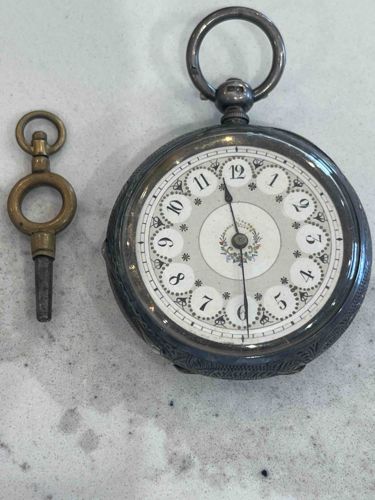
This item is an antique or vintage key-wind pocket watch, accompanied by its winding key. The pocket watch features a circular silver-toned or possibly blackened metal case, approximately 2-2.5 inches in diameter, with intricate, probably engraved or chased, floral or foliate patterns visible on the bezel and edge of the case. The watch face is off-white or light ivory in color, with elegant black Arabic numerals for hours 1 through 12. Each hour numeral is set within a decorative, possibly enamelled or painted, oval or cartouche, and there are smaller dots or elements marking minutes or subdivisions between the hours. The center of the dial features a delicate, colorful motif, possibly enamelled and depicting a small floral or wreath design in muted greens, blues, and perhaps some red tones, adding a touch of artistic flair. The hands are thin and dark, likely blued steel, with a classic spade or Breguet style. A small sub-dial for seconds is not immediately apparent, suggesting it might be a simpler movement or an open-face style without a seconds hand. There is a sturdy, fixed bail or bow at the top for attachment to a chain. The overall condition appears good for its age, with some visible patina on the metal case, suggesting genuine age rather than damage. There are no obvious signs of significant dents, cracks, or repairs, though a detailed inspection would be needed to confirm. The winding key is made of brass or a similar yellow metal, featuring a small ring at one end for handling and a squared post at the other for winding the watch. Its design is functional and typical for period winding keys. The combination of the decorative case and the intricate dial design suggests a watch from the late 19th or early 20th century, likely European in origin, indicating a respectable level of craftsmanship.
AI Appraisal Report
Upon examining the provided image of this antique key-wind pocket watch and key, I assess its overall condition as good for its age, noting the visible patina on the metal case which is consistent with genuine age rather than significant damage. The intricate floral/foliate engraving and the decorative, possibly enamelled, dial suggest authenticity for a late 19th to early 20th-century European piece. The distinct Arabic numerals within cartouches and the central floral motif are particularly attractive features.
In terms of market conditions, similar decorative key-wind pocket watches in good, running condition typically find a steady, albeit niche, demand among collectors of horological items and antique enthusiasts. Comparables in this condition, especially with well-preserved dials and cases, generally fetch respectable prices. The absence of a sub-seconds dial indicates a simpler movement, which might slightly temper value compared to watches with more complex complications. The accompanying winding key adds to the completeness and desirability of the set.
Factors significantly impacting value include the aesthetic appeal of the dial and case, the perceived originality of all components, and the overall state of preservation. The rarity of such intricately decorated dials in good condition also contributes positively.
It is crucial to note that this authenticity assessment is based solely on visual examination of the image. While the piece appears genuine, a full authentication would require an in-person examination to verify hallmarks, movement details (serial numbers, maker's marks), and functionality. Establishing the watch's running condition and timekeeping accuracy is paramount, as non-functional watches are valued considerably less. Provenance documentation, if available, would further enhance its value and confirm its history. Scientific testing of materials could also definitively confirm age and origin if required.